Triangle Strategy (PS5) Review
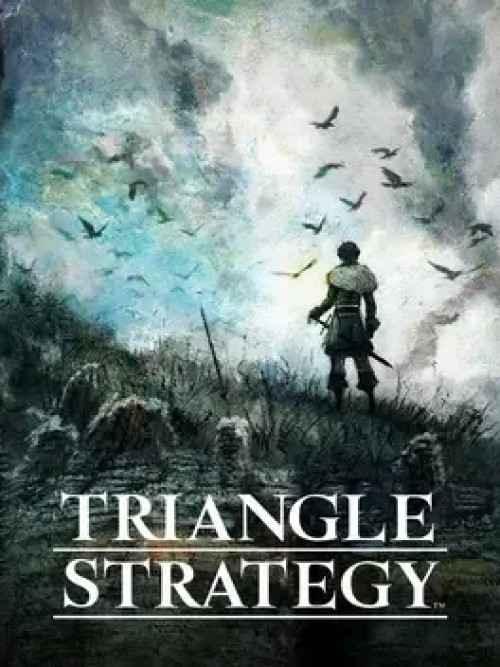
Triangle Strategy was originally released as a Nintendo Switch exclusive in 2022. It also got a PC port later that year. On August 20 2025, Triangle Strategy was announced and shadow-dropped for PS5 and Xbox Series X/S. There are lots of players who haven’t had access to this modern Square Enix strategy JRPG. COGconnected has reviewed Triangle Strategy for the Switch and PC already. The PS5 port is identical to those two versions. There’s no reason to rebuy it if you already have it. This review won’t re-explain the story and mechanics covered in the other two COG reviews, but will offer a different perspective on certain aspects of the game.
Triangle Strategy was developed by Artdink, as a spiritual successor to Octopath Traveler. Artdink is spearheaded by many of the same team who made the Bravely Default games. Triangle Strategy has a wholly different story and gameplay style than either of those series though. It’s a completely contained strategy JRPG in the same vein as Final Fantasy Tactics. It continues the HD-2D aesthetic created for Octopath Traveler though. The graphics are highly detailed 2D pixel sprites, over 3D backgrounds. Together they create a pop-up book-like visual presentation. Triangle Strategy also shares Bravely Default’s brown color palette.
Universal Acclaim
Just like the visuals, Triangle Strategy’s combat system seems to be universally loved in. Most of the game’s critiques have to do with its story and pacing. Most reviewers found the story of warring kingdoms to be quite gripping for the most part. But there are long story sections of cutscenes that threw off the pacing for many players. I didn’t find this to be a problem at all though. Part of the reason it worked for me is I love narrative-driven games. I also tend to enjoy medieval fantasy and JRPG genres. Playing a JRPG with a strong narrative focus is always going to intrigue me.
I think Triangle Strategy could have used a disclaimer or something at the beginning of the game. Most of the game is cutscenes and combat, and players were obviously caught off guard by the number of cutscenes. If the game was advertised as narrative first, I don’t think people would have had a problem with the pacing. The Japanese visual novel genre is getting more and more popular. And acclaimed games like 13 Sentinels: Aegis Rim had a similar balance of narrative and combat. 13 Sentinels: Aegis Rim was divided into visual novel and combat sections in the menu. It really let the player know that they were in for a lot of reading. I think Triangle Strategy’s pacing worked really well for me because I knew it was cutscene-heavy going in.
Atrocious Voice Acting
Another problem with Triangle Strategy’s cutscenes is that the English voice acting is atrocious. Almost all the voices were really stiff sounding. You could just tell there were people reading lines off the page, with no direction from anyone. They made a lot of the story sequences sound bland. The beginning of the game really dragged for me. I changed the audio to Japanese and the problem was instantly solved. The Japanese voice acting was such an improvement that I restarted the game. I heard complaints that the beginning of the game dragged, and I wonder if those people were struggling with the English voices more than the writing.
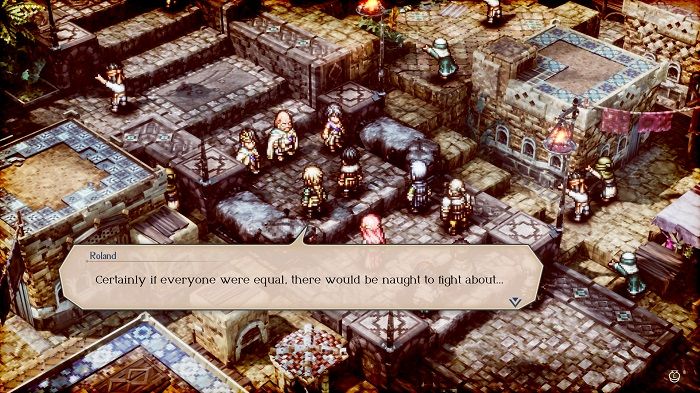
One important aspect of Triangle Strategy I would really like to highlight is the conversation system. The major events in the game are fairly linear, but lots can be changed by choices the player makes. During cutscenes, there are times when the player gets to choose between different dialogue options. Conversations have three invisible parameters: utility, morality and liberty. Each choice puts unknown amounts of points towards one of the three parameters. The events of the game change based on which parameter is strongest. This system makes it so the player isn’t totally passive during dialogue-heavy sections. And it gives Triangle Strategy crazy replay value, if a player wants to experiment and see different outcomes to events.
Lots to Enjoy
I enjoyed Triangle Strategy more than most reviewers, and I don’t love most strategy JRPGs. I love JRPGs, but prefer them turn-based or action-oriented. Triangle Strategy has an epic, gripping medieval fantasy narrative, and I urge anyone curious to give it a try knowing this. The game doesn’t advertise how cutscene-heavy it is, but knowing that going in really helps. Fans of visual novels, tactical games, and JRPGs all have something to chew on here. Unfortunately, the PS5 port is almost the same experience as the Switch and PC versions. It just has the expected visual upgrade that comes with a more powerful console. But it’s a treat to finally have this fantastic game on all modern consoles.
***PS5 code provided by the publisher***
The Good
- Gorgeous HD-2D visuals
- Deep narrative
- Choices matter and add great replay value
The Bad
- English voice acting is awful
- Could be too many cutscenes for some
- No upgrades from the Switch or PC versions