My Hero Academia: All’s Justice Review
The My Hero Academia anime finished airing in 2025, and Bandai Namco has released My Hero Academia: All’s Justice to celebrate the completion of the series. This is the third game in the 3D arena fighter series that began in 2018 with My Hero Academia: One’s Justice, and continued in 2020 with My Hero Academia: One’s Justice 2. It’s been six years since the last game in the series. That means the games haven’t gotten stale. My Hero Academia: All’s Justice covers the narrative of the final few seasons, and has a humongous roster of almost every character a My Hero Academia fan could hope for!
My Hero Academia: All’s Justice is a 3D arena fighter similar to the Naruto: Ultimate Ninja Storm games. Square performs a melee attack combo. X is jump. L1 is dash. R1 is guard, and flicking a direction while holding R1 dodges. Flicking the right joystick on its own also dodges. Holding R1 while pressing triangle performs a counterattack. And holding R1 while pressing square performs an unblockable attack. Triangle and circle are character specific special attacks (called “quirks” in the My Hero Academia universe). There are two other quirk attacks performed while pressing triangle or circle right after flicking the left joystick. Gameplay is triple tag. Partners can be tagged-in by pressing L2 and R2.
3D Arena Fighting Controls
In addition to an HP gauge, characters also have a stamina gauge. Stamina depletes when guarding and dodging, but gradually increases over time. A character’s “Plus Ultra” super move is performed by holding R1 and pressing circle. It uses a bar from the Plus Ultra gauge. Pressing L2 and R2 during a Plus Ultra adds a tag partner’s Plus Ultra attacks to make a super combo. There’s also a Rising gauge, which can be activated when full by pressing R3. Pressing R3 can do an emergency dodge. A Rising action is performed by holding R1 and pressing circle while Rising is activated.

It’s a solid battle system. Not one of the all-time greats, but solid for a 3D arena fighter. Where the gameplay shines is its massive roster of 68 characters. The only characters I could think of wanting to use that weren’t offered were Mount Lady and the UA Principal. My first derpy team choice was All For One, Aoyama, and Gentle/ La Brava. Each character feels unique, and the triple tag format keeps battles feeling chaotic and fresh.
Starts With a Bang
My Hero Academia: All’s Justice immediately starts with a battle between Deku and Shigaraki. It’s at the point where Shigaraki is full Tetsuo at the end of Akira. The narrative just covers the end of the My Hero Academia story. While My Hero Academia: All’s Justice has the definitive full roster, it really is a story sequel that has to be played after the other two games. This opening battle functions as a flashy intro and a bit of a tutorial.
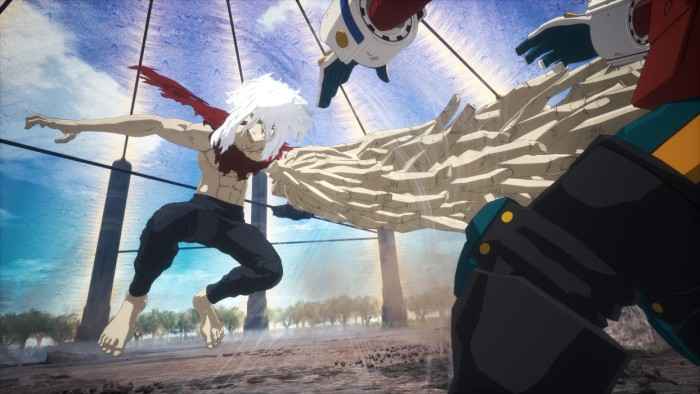
Starting the game with an unskippable battle before taking the player to a menu was an annoying choice. I get that the devs wanted an exciting intro to the game, but I was thrown off too much by how bad the English dubbing was. I watched the anime in Japanese, and hated Deku’s English voice actor. After the opening battle, I had to make some immediate changes in the options menu. I changed the voices to Japanese, turned off a weird motion blur effect that was on by default, and changed the hub crowd density from “low” to “standard”. I’m guessing these choices were made to preserve a solid framerate, but I always choose visuals over framerate.
Virtual Musutafu City Hub
After the opening battle, My Hero Academia: All’s Justice slows way down. Deku is in a virtual hub of Musutafu city. He gets to traverse the city and look for side missions. Deku can also check his smartphone, which has all the menu options. Traversing the hub is fun. Different characters have different abilities to get around. Deku has a Spider-Man-like swing with his black whip, while Uraraka has a high floaty anti-gravity jump. It’s a very empty feeling city though, even with the crowd density turned up. Unfortunately, this virtual hub is an early indication of the game’s lower budget.
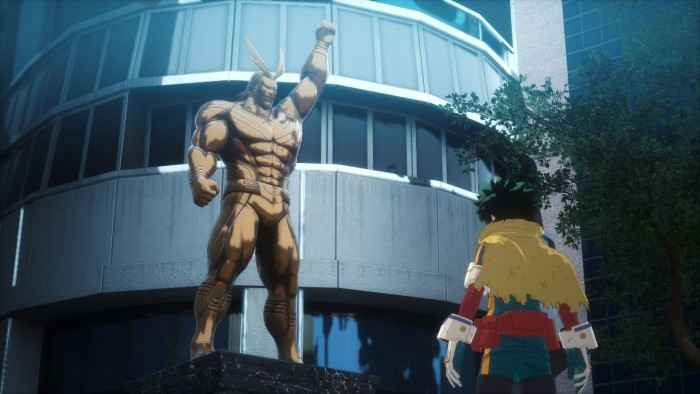
You can really tell from some of the animations that My Hero Academia: All’s Justice is a bit of a budget title. The game somewhat masks its lower budget with a sometimes excellent presentation that captures the vibrant feel of the anime. The character models are all extremely accurate. But there were small bits of lack of polish. Even though I changed the audio to Japanese, there were still some occasions where the voices switched to English for a line or two. And there was more Japanese dialogue than I would’ve like that didn’t have subtitles.
Story Mode
The first option from Deku’s smartphone menu is Story Mode. It covers the entire Final Act Saga. Story Mode has some animated in-game cutscenes, but a lot of it is told through still images of anime footage. The end result is really unfortunate-looking. It’s just not a presentation up to modern standards.

The second Smartphone option is Team Up Missions. Team Up Missions are different objectives scattered around the hub city. Deku usually goes to the aid of two friends. These battles have bonus objectives, like “finish your opponent with a Plus Ultra attack”. Some missions involve walking around and chatting to folks. It’s a lot of JRPG sidequest busywork that most modern players hate. Some people might like the ease and the coziness of Team Up Missions, but, for me, they felt more like padding than enriching content. S ranks in Team Up Missions give rewards, but they’re mostly cosmetics like badges, banners, and poses.
Free Battle
Free Battle is the real meat of My Hero Academia: All’s Justice. This section has two player versus mode. There’s no arcade mode, but players can select single player vs. CPU fights at five different difficulties. There’s also a Network section where players can battle online. Some augments can be made before setting up fights, like battle time, and starting with a full Rising gauge. Players can also choose whether to use a modernized auto combat system or not, and if they want joystick inputs to be flicks or holds.

Archives Battle is a section with Story Mode-style battles based on events from earlier in the My Hero Academia series. Character Memory lets Deku have conversations with characters he’s unlocked in the hub area. In addition to the Tutorial Mode, there’s also a Training Mode, where players can practice moves and combos.
Customize Menu
The final menu option is Customize. The best part is that it lets the player edit character appearances. Most of the palette swaps have to be unlocks, and 90% of them are just color variations. There’s also a Customize Profile section where unlockables can be applied to the UI and system sounds. It’s a nice bonus, but not an important feature.

I have mixed feelings about My Hero Academia: All’s Justice. At its core, it has a good 3D arena fighter battle system. Its best feature is its massive dream roster of My Hero Academia characters that all feel unique from one another. But almost every bonus mode and feature feels cheap and undercooked. Everything except the combat seems like an afterthought. But if all you’re looking for is versus battles with tons of My Hero Academia characters, then My Hero Academia: All’s Justice is a dream come true.
***PS5 code provided by the publisher***
The Good
- Huge roster of characters
- Fun 3D arena combat
- Characters feel unique
The Bad
- Story Mode is cheaply thrown together
- Team missions feel like busywork
- Awful English voice dub