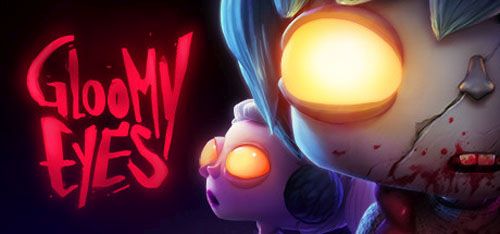
Gloomy Eyes Review
Gloomy Eyes began life as a 2019 VR movie. With Colin Farrell as the narrator, the 30-minute film was a Tim Burton-esque story about the unique friendship between a zombie child and a human girl. It was set in a perpetually dark world where the sun had disappeared. The film was charming and deeply melancholic, and a great showcase for short-form VR films. Six years later, Gloomy Eyes is a game. It’s both better than, and not quite as effective as, the movie version.
Forbidden Friendship
Mechanically, Gloomy Eyes borrows some mechanics from recent co-op games like It Takes Two, though it’s a single-player experience. This translates as two main characters with complementary abilities. Gloomy is a zombie child with the ability to grab items and throw them, but he can’t stand in or travel through lighted areas. The human girl, Nena, can jump distances and flip switches and, most critically, can move through the light. Unfortunately, she can’t get too close to zombies like Gloomy. The unlikely friends band together to try to bring back the sun. Nena has a zombie-hating uncle and minions who add additional tension to the story.
While I wouldn’t call Gloomy Eyes joyous, there are heartwarming themes around appreciating friendship, cooperation, sacrifice, and finding the good even in bad situations. Those ideas come through in the game just as in the movie.

Aside from the narrative that drives it, nearly the entire five hours of Gloomy Eyes’ playtime is spent solving environmental puzzles by finding and using objects or switching between the two characters and their abilities. There are a few sequences that are pure story beats. At times, the narration and exploration take center stage.
As puzzle games go, Gloomy Eyes isn’t too frustrating. Usually, understanding the solution is less of an issue than controlling the camera or missing some too-well-hidden object or path. There is a rotatable diorama view, which is great for seeing the stage as a whole, at least when you can actually rotate it. One of the game’s small frustrations is not being able to rotate the camera during regular gameplay. Sometimes finding just the right angle to throw an object or find an object is a finicky test of patience.
Enchantment, Hope, and Despair
The VR version of Gloomy Eyes was dark, haunting, and beautiful, and the game is equally atmospheric. There’s a lot more detail in the game, and the diorama view suggests the same sort of exquisite miniature world that made the VR version so compelling.
Part of what makes Gloomy Eyes feel like a timeless fairy tale comes via the narration. It’s written beautifully and voiced by Eric Nolan. Niko Wasterlain’s mostly acoustic score very faintly echoes both Danny Elfman’s music and the score from the original VR film. It perfectly matches the tone of the visuals.

Losses and Gains
Gloomy Eyes — the game — is much more than an interactive movie. It’s really an entirely new experience built from the same fundamental story and art direction. I suspect that very few players will have seen the film, but they should, as it fills in some story beats missed in the game. It’s a compact fairy tale, and the film’s short running time meant that not a moment was wasted.
On the other hand, the game’s pacing entirely depends on the skill and smarts of the player, and not getting bogged down in a puzzle, killing the momentum of the story. It sometimes feels like the game adds more complications than the narrative can support.

Overall, Gloomy Eyes is an engaging, enchanting experience. The complementary abilities of its two protagonists allow for interesting puzzles, and its story has a lot of heart despite the gloom. I liked the VR film, but the game is an equally enjoyable take on a haunting little tale.
***Xbox code provided by the publisher for review***
The Good
- fantastic art direction
- interesting narrative
- accessible puzzles
The Bad
- camera controls
- pacing can be inconsistent