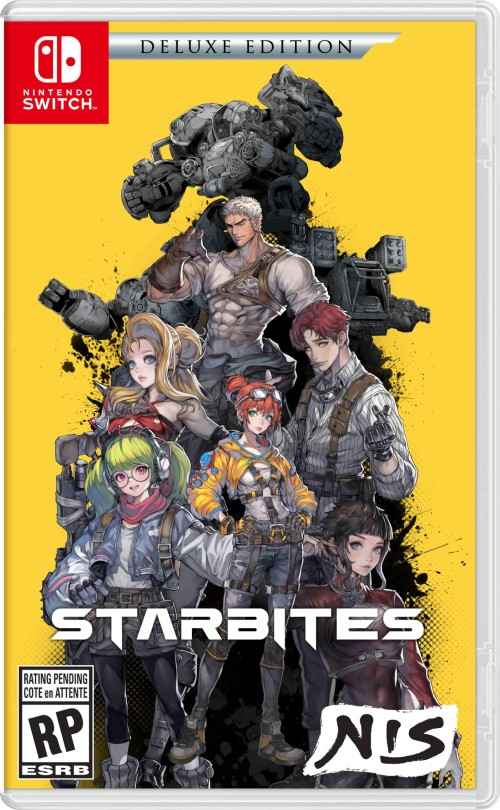
STARBITES Review
Do you like JRPGs? Have you ever played a modern JRPG and wished there were more throwback offerings? I don’t mean throwback as in 2D pixel graphics, or fantasy tropes. Are you looking for a back-to-basics JRPG that isn’t trying to innovate, but is trying to provide you with a cozy experience that isn’t a farming game? STARBITES is the game you’re looking for. Gameplay-wise, it might as well be an NES Dragon Quest game. Read on to find out more about this lovely gem of an adventure.
STARBITES is about Lukida, who was born into her parents’ debt. She didn’t ever know them, but her parents’ debt has forced Lukida to spend her whole life working for her rich boss Fennec. Lukida is looking for a life outside of Delight City. STARBITES starts off about Lukida losing a ticket that will take her off world, but the story escalates quite a bit. Writing more would be too much spoiler, but I really enjoyed the plot, even though it’s mostly a vehicle for the characters and world, all of which are excellent.
Desert Robot World
STARBITES has a fun world build. It’s an almost steampunk aesthetic. The town of Delight is full of robots and scrap in the same way a post-Road Warrior story like Battle Angel Alita has. The environments outside of towns are all desert. My only complaint is that, because the entire game world takes place in a desert, a lot of the outside locations can feel too similar. The locations all look great, but they’re bound by the logic of an entirely desert biome.
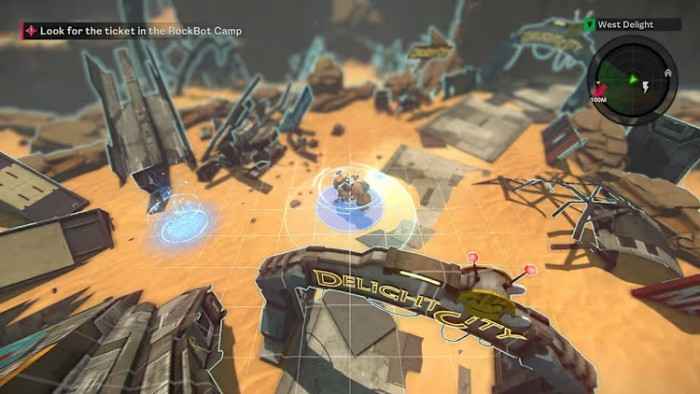
STARBITES’ combat is turn-based. The player commands are attack, skills, guard, items, and escape. All enemies have elemental weaknesses, and a barrier that can be depleted by exploiting them, similar to the combat system in Sea of Stars. Depleting an enemy’s barrier breaks them, which makes them miss several turns and makes them take extra damage. Turn order is displayed in the top left of the screen. Characters have a DH gauge, which allows a player to activate a “Driver’s High”, by holding R2, when full. This can be activated at any time, and allows that character to immediately perform an attack or skill.
JRPG Basics
When a character gains enough experience points they level up. Level increases lead to stat bonuses. Every character gains new skills at fixed levels. They also get a talent point, which can be put towards unlocking stat bonuses or passive abilities on a skill tree. Characters each have their own skill trees, and they can be reset at any time without any penalty. Character equipment takes the form of vehicle upgrades. Each vehicle has a weapon slot, three armor slots, an engine slot, and a core slot. Cores are like accessories with different bonuses.
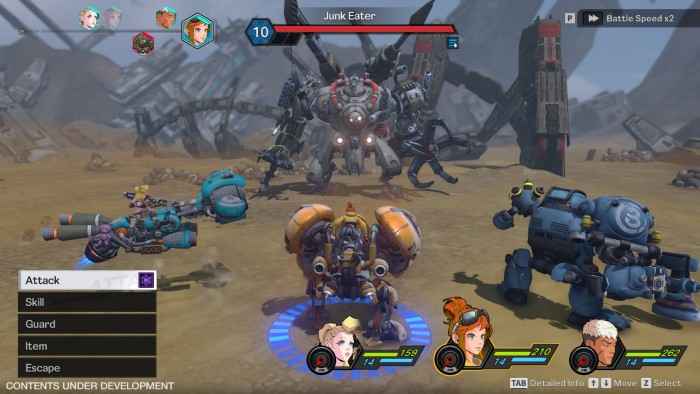
Outside of combat, characters explore deserts and walk through towns. Towns have NPCs to chat to and shops to visit. Desert save points all repair vehicles for free. Towns are navigated on foot and have fixed camera angles like a PS1 game. The environments are fully 3D, but the camera is often placed to make areas feel a bit like a side scroll. The explorable deserts have a top-down perspective. Characters fight and traverse the desert in vehicles. Lukida pilots a small mech called a Motorbot, and I love how the physics of walking around as Lukida feel lighter than piloting her heavy bot.
Nice and Cozy
I loved all these aspects of STARBITES. I really enjoyed the story, characters, and world. The JRPG combat and systems felt very familiar. I loved exploring the environments. It’s all very simple, and basic. Some players are not going to like how straightforward STARBITES’ ideas are. The game innovates nothing. But I really liked how I could just shut my brain off and enjoy playing.
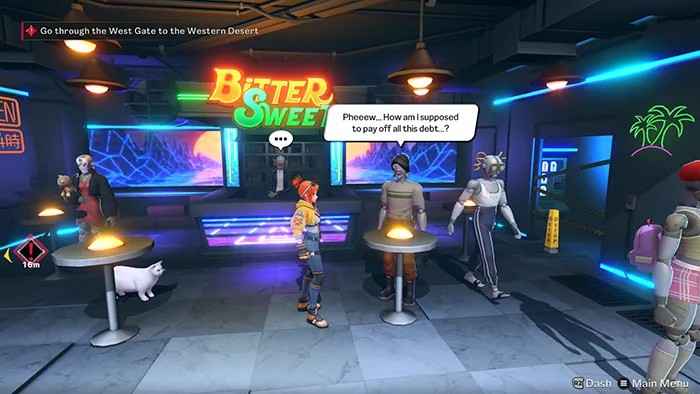
I have some specific critiques, though. The game is definitely too easy. STARBITES has three difficulty options, which can be changed at any time. I recommend most players start on hard from the beginning. Load times are all a little too frequent and too long. I didn’t like the map system. There seems to be a modern video game movement away from in-game maps. I love maps, though. I’m old enough to have played games like Metroid and Phantasy Star, where I had to draw my own maps on graph paper. STARBITES has no map in towns, and has a radar with some markers on it. A proper map can be opened by pressing triangle while exploring, but it’s difficult to read. I wish the game had an option for a much clearer map.
Ambitious Indie Presentation
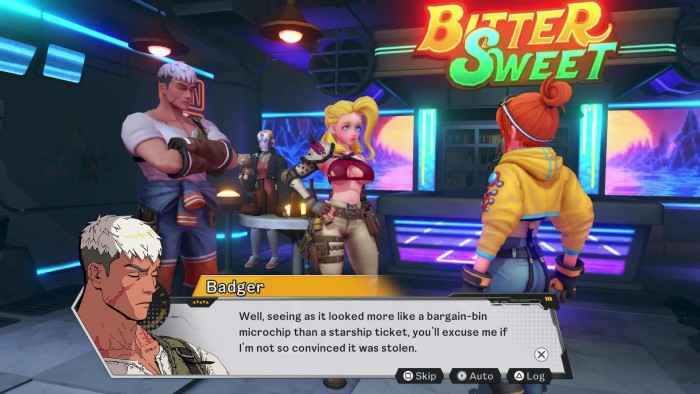
STARBITES is a lower-budget game, but it makes the most of its presentation. The character models have a chunky anime-tinged Disney aesthetic. The 3D modelling reminds me of a PS2 game like Kingdom Hearts or Rogue Galaxy. Environments are full of detail. Character portraits are gorgeous. STARBITES sets a high standard of presentation for lower-budget games.
I loved STARBITES’ score. A lot of it is chill and breezy feeling. There’s a great mix of jazz, acoustic guitar, and light synths. It’s an a-typical JRPG soundtrack, and it’s also very memorable. The music does change a little too abruptly when entering new locations or menus, though. It can be jarring, and annoying when really vibing to what was just playing. STARBITES has full English voice acting, but it starts set to Japanese. The player has to go into settings on the main menu and change the voice acting to English. I’m usually a big fan of Japanese voiceacting, and struggle with a lot of North American English dub casts, but STARBITES has excellent English voice acting. I’m really surprised the game doesn’t start with English as the default setting.
Simple and Clean
STARBITES is a very simple JRPG, but I think that’s one of the game’s strengths. Almost all of its systems are stripped down, and easy to understand. It’s not an innovative game, and it’s not a challenging game. Anyone who likes the idea of a straightforward cozy JRPG should absolutely check it out. If you want Dragon Quest with robots, STARBITES is the game for you.
***PS5 code provided by the publisher***
The Good
- Fun back-to-basics JPRG gameplay
- Creative world build
- Aesthetics conquer their budget
The Bad
- Load times are frequent
- The map sucks
- Very easy