Dragon Is Dead Review
Dragon is Dead is a Roguelite 2D hack and slash. It’s been available on PC for almost a year, and now it’s finally made its way to consoles. COGconnected reviewed the PC version, and not much has changed aside from a bit of bug fixing and polish. There’s no reason to get the console version if you’ve already played the PC one. But if you’ve never played Dragon Is Dead before, let us tell you all about it…
Dragon Is Dead’s story is pretty sparse. The player controls an undying warrior on a quest to stop a God-like dragon from opening demon-spewing rifts across the land. There are lots of NPCs and items that drip-feed the story and world lore to the player. But the narrative is actually quite simple. I really enjoyed the world, but a few of the NPCs are a bit long-winded. Everyone has a small bit to say, but takes a long time to say it. I could see this being a big problem for some players. Thankfully the dialogue doesn’t repeat across multiple runs. Repeat runs even unlock new NPC encounters.
Hack and Slash
Dragon Is Dead’s controls are a pretty basic 2D hack and slash set up. Square does a melee attack, which can be turned into a short three-button combo. Square can also be held to perform this combo. Melee hits fill the magic meter. X is jump, and twice to double jump. Circle + a direction performs a dodge. The player can dodge through projectiles. Triangle acts as an action/ talk button. Shoulder buttons can have different skills equipped to them. Up on the d-pad uses healing items. I personally hate it when items are mapped to the d-pad. I like to use it for 2D movement more than a joystick, and I hate when I can accidentally use precious consumables with a single button press. Aside from that, the controls are fundamentally sound, and combat and movement feel great.
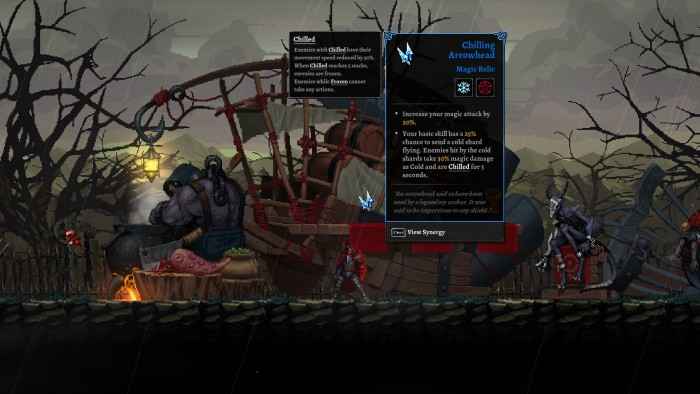
Dragon Is Dead is a Roguelite. Death respawns the player at the beginning of the game. All the player keeps is their equipment and their knowledge of what they just went through. Unfortunately, I don’t think the game benefits from its Roguelite structure. Playing the same levels over and over gets repetitive. And all experience, money, skills, etc. are lost. The equipment the player keeps doesn’t create enough addictive forward momentum.
Linear Progression
Dragon Is Dead’s progression is also very linear. There aren’t any secrets or branching paths. The map doesn’t have a Metroidvania-like structure. The gameplay loop is to defeat all the enemies in a pretty flat environment, to unlock a choice of chests. The chests are randomly generated and have a theme, such as artifacts or currency. The player chooses one of two chests, then chooses one of three rewards. The problem with this system is that if the chests don’t contain great rewards, runs can become pointless.
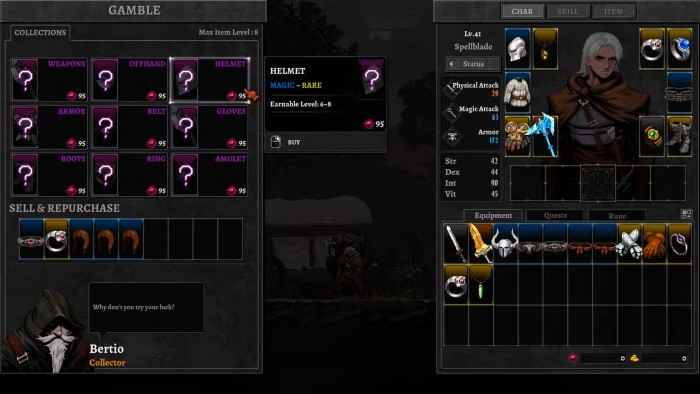
Pressing the control pad brings up a very cluttered CRPG menu. It looks like a menu meant to be navigated with a mouse. There are tons of player stats. Some of them seem needless. For example, the main menu displays character stats for strength, dexterity, intelligence, and vitality. On the same menu there are weapon stats for combat power, damage, and armor. Pressing L3 brings up a weapon submenu with core stats, attack, defensive, resource, and mixed. Pressing X on attack reveals 21 other stats related to attack. It’s too much. And because there’s so much going on in these menus, upgrades feel like they don’t mean a lot. They just affect these many stats in minute ways.
Overly Complicated UI
The main character menu also shows ten equipment slots. Below these are menus for gear, quests, and runes, which can be scrolled with the L1 and R1 buttons. Pressing L2 or R2 opens a skill tree page, and an item page showing artifacts and their synergy and essence. Artifacts and gems are both essentially ability granting/ stat boosting accessories. They’re another example of how Dragon Is Dead overcomplicated its systems. I wish they differentiated in that one of them stayed with the player after death.
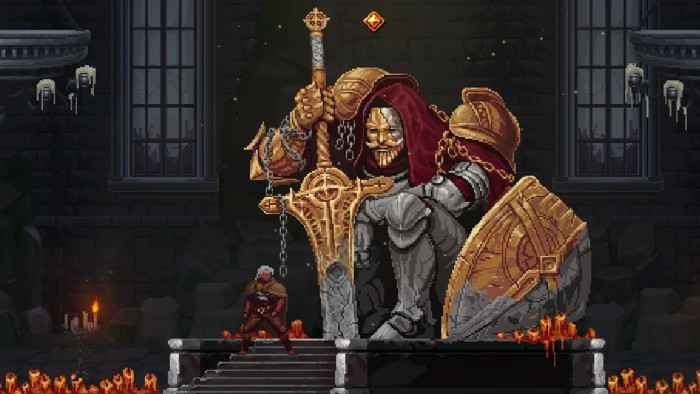
The main draw of Dragon Is Dead is its gorgeous aesthetics. I love its dark fantasy world. The pixel art used to create it looks stunning. Environments have incredible detail. The enemy design is creative, despite being traditional fantasy-themed. The music is a melancholy traditional fantasy score that supports the gloomy world well. There aren’t any memorable melodies, but the score services the game’s tone. Anyone who’s a fan of pixel art needs to play Dragon Is Dead. It’s truly a sight to behold.
Mixed Results
Dragon Is Dead is a very good hack-and-slash game, but it’s a pretty poor Roguelite. I wish the game had more carefully crafted levels, with well-placed items. The game’s pixel art and dark fantasy world drove me to keep playing, but the Roguelite systems didn’t. There are also way too many systems and ideas that need streamlining. The game has enough good elements that 2D hack and slash and Roguelite fans should still check it out. Dragon Is Dead just isn’t a great example of the genres merging.
***PS5 code provided by the publisher***
The Good
- Gorgeous pixel graphics
- Solid 2D hack and slash gameplay
- Dark fantasy aesthetics
The Bad
- Roguelite rewards don’t drive player forwards
- RNG can ruin a run
- Too repetitive
- Overly complicated UI