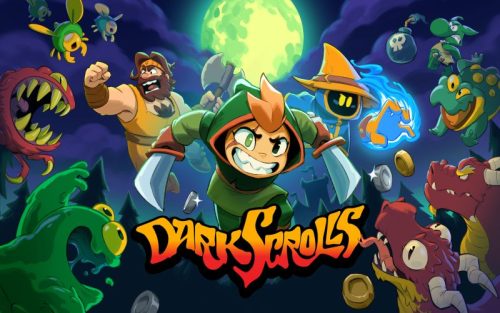
Dark Scrolls Review
Dark Scrolls comes to Steam and Switch 1/2 from Doinksoft, which bills the game as a fantasy-themed action platformer that melds with other gaming genres such as rogue-lites and shmups. Besides all that, the game screen automatically scrolls the level from left to right, which adds a level of tension to navigation. You can take one of nine characters – each of them with their own unique quirks – on your quest. You can do quests in solo or cooperative play.
Every playthrough offers a different adventure due to the game’s randomly generated stages. Also, there are three different routes or quests you can take. You can take the high, medium, or low road. So you’ll end up either on the moon, in hell, or in a castle. All the characters and routes add to the replayability of the game.
What is common across all three routes is that you’ll have to battle hordes of enemies and deadly traps. How you do that will be in some part decided by the character you choose. There are nine characters, of which three are available at the start. Those three are your standard character types. There is Grizz the barbarian, Emerys the mage, and Pigeon the thief.
Each character has a standard attack plus a special ability. Grizz is the tank who loves ground pounding and axe-lobbing. Emerys throws fireballs and can blink-dash. Pigeon is the agile one who has a double jump and can hurl dual daggers. Special abilities for each include Pigeon’s stealth, which renders him temporarily invisible and able to deal critical hits. Emerys can summon magical orbs that destroy projectiles and damage enemies. Not to be outdone, Grizz’s special ability is the Axe Nova. This talent creates a bouncing circle of axes that fly across the screen.
Dark Scrolls’ Cast of Characters
The remaining characters are: Biscuit the dog, Quinn the cupid, Confit the chef, Ironbeard the dwarf, Saturn the alien, and Nezumi the bard. Each of these characters requires completing a specific objective. Except for Nezumi who is purchased from the game’s shop. They all have primary and secondary attacks that, while quirky, are just variations of the attacks from the three starting characters. For example, Ironbeard can launch pickaxes, create temporary platforms by double-jumping, and build a cannon and fire cannonballs at enemies. Then there is Saturn, who can fly while firing an alien machine gun or use a tractor beam to suck up enemies, coins, and more to level up.
In theory, all these characters and their abilities would lead to very different gameplay experiences. In reality, these powers are mostly very much alike. The best platforming games work when there is an engrossing level of complexity to keep you engaged. Complexity from level design or gameplay. Complex level design creates a great sense of exploration, while complex gameplay engages you with combos and button presses. Unfortunately, Dark Scrolls has neither of these. Its complexity comes from paying attention to what is happening on screen. This dynamic is more fatiguing than enjoyable.

Dark Scrolls tries to keep things interesting by including a perk system. During runs, you will collect coins to use at the mid-level Perk Shop. However, there is a catch. This means that you can only use perks after attaining an appropriate Star Level, even if you have already bought them. Your Star Meter charges up when you damage enemies. When you use your character’s special move, the meter is reset to zero. This is how you recycle through your perks.
Perks provide different effects for special attacks, enhanced movement, summoning allies, and other abilities. Because each perk needs a different star level, you can create scenarios where you can launch one, more, or all of your perks when you reach the proper Star Meter level.
Perks, Trinkets, & Side Objectives
But wait! There’s more than just perks. There are also Trinkets. Trinkets are equippable items that boost your character’s abilities and perks. There are ten of them with the Heart Pin as the base one. The Heart Pin increases your Hit Points by two. To equip trinkets, you must complete character side objectives. The first side objective equips the character with a trinket slot. The second one gives the player crystals to buy trinkets, and the third side aim unlocks new trinkets.
So we come to Dark Scrolls’ major frustration. The game feels unfinished. The coins and points end up being the same thing. If you die with coins, the game converts them to points. This renders the difference between the two mute. Then, the mechanics of how abilities and Star Levels are managed present a problem. The limited time of use is annoying because if you want to use that power again, cycle back through to that star level to do so. Some may like the challenge; others, like me, will find it annoying.

Further to the above issue, there is a lack of information about the game’s settings and characteristics conveyed to the player. There is little to no explanation for each setting. Settings are finicky and not responsive. Take the volume controls for example. Turning the SFX volume down does not control all sounds. Some play at a locked-in and too high volume. Further to that, if you want to change sound settings in-game, you can’t. You have to exit to the main menu.
Other shortcomings of the game include the characters themselves. While their abilities may be different, they have the same effect. The auto-scrolling pace can be frustrating too. Sometimes it scrolls too slow so you have to wait for it to catch up to you.
Game Strengths
The game’s strengths lie in the artwork and the music. They harken to the 8-bit era of gaming and evoke memories of Ghosts and Goblins and Super Mario. However, this game doesn’t have the same flair as those games, which can be partly because of the lack of a nostalgia factor.
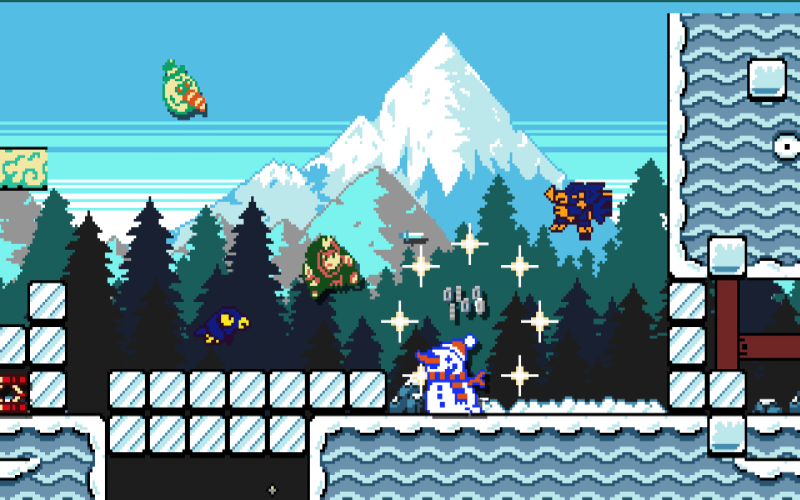
Dark Scrolls looks and plays like an old-school 8-bit game, but it doesn’t have the refinement and diversity of the top games from that era. Even in co-op or multiplayer, the game lacks polish. You can only revive a fallen character after completing a level, even if you fill up your HP bar. However, a fallen player can still pick up lives, which hobbles the other players that are still alive. While Dark Scrolls has the look and feel of a classic side-scrolling platformer, it just doesn’t have fleshed-out technical underpinnings and gameplay variety to make it stand out in a crowd unless you have a real strong nostalgia for that era.
***Steam Review key provided by publisher***
The Good
- 8 bit art style
- catchy music
- alternate routes
The Bad
- repetitive gameplay
- frustrating controls
- buggy