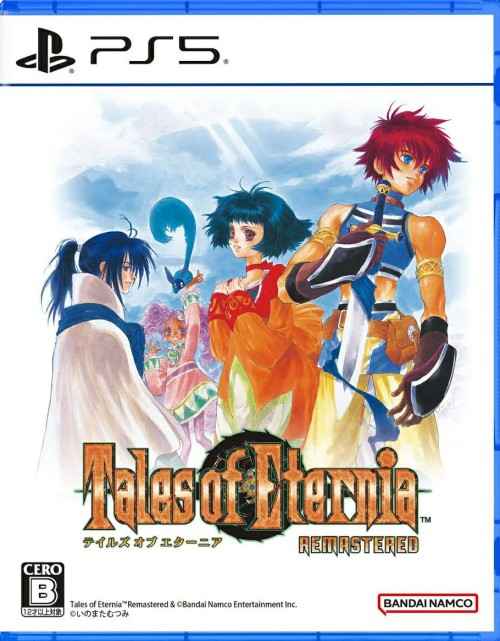
Tales of Eternia Remastered Review
Tales of Eternia was originally released in North America as Tales of Destiny II for the original PlayStation in 2001. It’s one of those JRPGs that had a smaller print run, and has cost in the $200-$300 range at retro game stores for the past decade. Because of this, it’s one of the Tales games that’s been played the least by modern audiences. Tales of Eternia Remastered is gorgeous visual remaster of this rarely played action JRPG. It’s been retranslated to be closer to the original Japanese text, and features some quality-of-life upgrades. Read on to find out if Tales of Eternia Remastered is the retro JRPG experience you’ve been looking for.
North America didn’t get the first Tales game, Tales of Phantasia, in its original Super Nintendo incarnation. The first time we got it was its Game Boy Advance re-release. So the first Tales game we got, in North America, was the second game, Tales of Destiny. Tales of Eternia is the third game in the Tales series, which is why it was titled “Tales of Destiny II” in North America. Like most Tales games, Tales of Eternia is a stand-alone story, and Tales of Destiny doesn’t have to be played to fully enjoy the game’s narrative.
A Tale of Two Worlds
Tales of Eternia’s story is about childhood friends Reid, Farah, and Keele, who live in a small village. Shortly after the game begins, they meet a mysterious girl who speaks a different language, and seems to have powers. They live in a world with a giant rig in the sky called the Orbus Barrier. It’s a divider between two worlds. They notice it changing color, so the friends venture into the big city with the mysterious girl, to see if the King has any information, and the plot escalates, heavily. This narrative is fantastic. The dialogue and some of the character writing can be a little JRPG trope heavy, and the pace is pretty slow. But when playing the game to completion, the plot, and world building, are real highlights.
Tales of Eternia’s combat features the linear motion battle system from Tales of Phantasia and Tales of Destiny. The player controls one character, and applies strategies to the other characters, like “attack nearby enemies” or “attack aerial enemies”. The player can switch characters at any time, but there are lots of AI strategies to assign, and combat flows better if the player generally concentrates on controlling one character.
Linear Motion Battle System
Circle performs a basic attack. Pressing the joystick in different directions results in different attacks. The player has to attack strategically. For example, if an enemy is flying, the player should press up with attack to do an upwards attack. This will knock the enemy to the ground, and the player can combo/ juggle the enemy on its way to the ground. Holding square blocks. Character specific skills are assigned to the X button. They can be changed at any time via a menu that can be brought up by pressing triangle. Skills cost TP, and are instantly activated, like attacks. Magic spells have different charge times, depending on the spell.
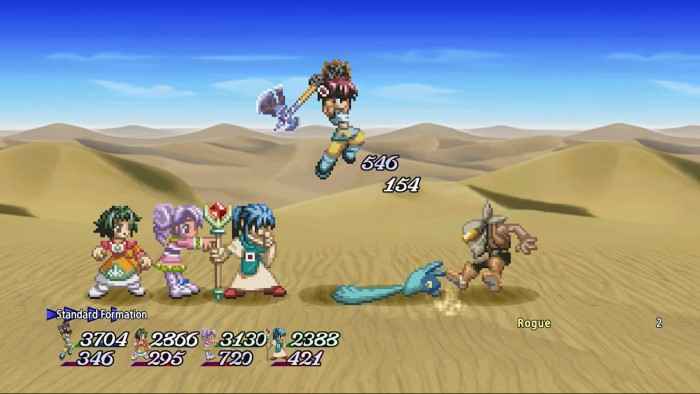
Tales of Eternia’s 2D action JRPG combat is one of its highlights. It almost feels like playing a fighting game, and totally holds up by modern standards. But it can get a little repetitive. The game is quite long and there are sections that feel like padding. Modern players will likely find the narrative unfolds a bit too slowly for their tastes, and that the third quarter drags quite a bit.
Remastered Visuals and Sound
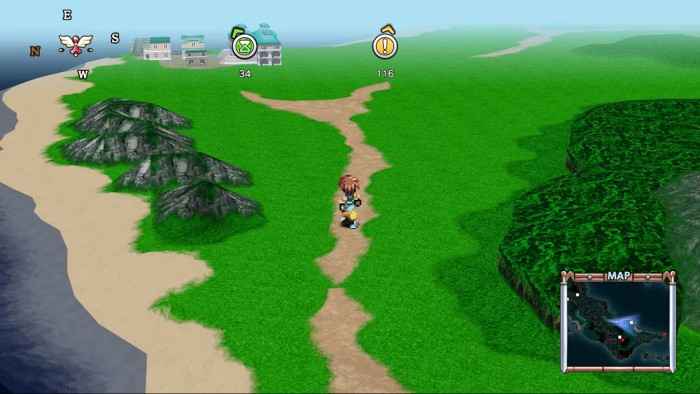
Most of Tales of Eternia Remastered’s remastering comes in the form of remastered visuals and sound. There are a few new quality of life features though. Markers appear on screen showing the main and side player objectives. This is helpful for players who might not be used to prerendered backgrounds. There are also customization options from the main menu, including difficulty options, and Japanese voiceacting. Certain gameplay elements can be toggled on/ off, such as dialogue skits, voiceacting, objective icons, etc.
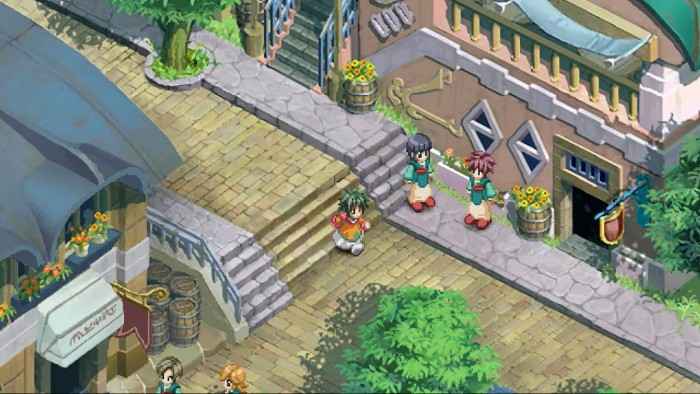
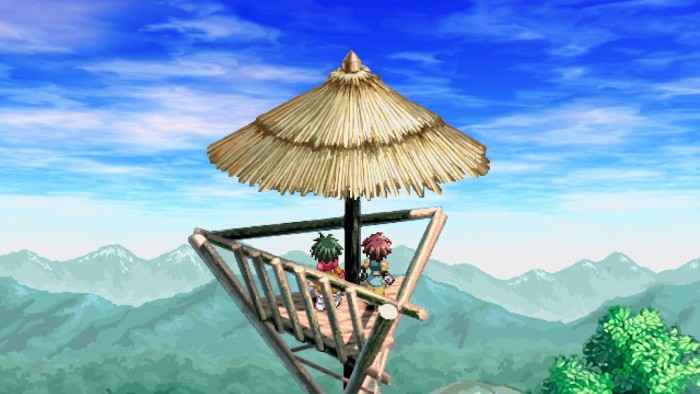
Although Tales of Eternia Remastered has remastered visuals, it was already one of the most gorgeous examples of 2D pixel graphics ever. It was the final 2D game in the series, before moving to 3D with Tales of Symphonia. The original PlayStation had very few 2D games, and those it did get were like Super Nintendo games on steroids. They were the pinnacle of 2D pixel art, and the original version of Tales of Eternia was no exception. I might even argue that the new smoothed game looks a bit worse than the original. Thankfully, there is the incredible option to switch between remastered and original visuals! The original visuals are still presented in widescreen, and have modern clean text and menus.
90s Anime Cutscenes
Another aesthetic treat for many players will be the anime cutscenes. Tales of Eternia Remastered has beautiful 90’s anime aesthetic animated sequences. They’ve had a smoothing filter applied to them, like the anime scenes in the Lunar Remastered Collection. This is likely because the original scenes were extremely low resolution and heavily pixelated. The remastered scenes are presented in widescreen. Even if the player sets the graphics to original presentation, the cutscenes have modern smoothing/ 16:9 framing. Tales of Eternia Remastered’s music is solid JRPG whimsical fantasy score. It’s good, but not truly noteworthy. There’s also an option to switch between remastered and original score quality. The frequent voiceacting is okay. It’s typical English anime voiceacting that really sounds like actors reading lines by themselves.
I’m so happy Bandai Namco finally released Tales of Eternia Remastered. It’s the first of the series’ 2D games to be brought to modern consoles. It’s also one of the games modern Tales fans really haven’t had any access to. I really loved playing through it again. The combat system will appeal to action JRPG fans, as well as fans of 2D fighting games. But the adventuring, dialogue, and pacing are full of JRPG bad habits that modern players have grown tired of. If you’re a Tales fan and/ or a retro JRPG fan, Tales of Eternia Remastered is a must-play.
***PS5 code provided by the publisher***
The Good
- Gorgeous pixel art visuals
- Classic Tales action JRPG combat
- Interesting world build
The Bad
- Lots of JRPG tropes
- Pacing drags
- Voiceacting isn’t great