Mortal Shell 2 Review
If you’re a Soulslike fan, you’ve probably played 2020’s Mortal Shell. Developer Cold Symmetry took FromSoftware’s challenging formula and made some interesting changes, like the shell system and setting the game in a darker world more akin to a heavy metal album cover than knock-off Tolkien. Mortal Shell had brutal, satisfying combat and visually striking aesthetics. But it was clear that the game was more proof-of-concept than a fully fleshed-out world. With Mortal Shell 2, all that’s changed. I’ve played few sequels that iterated so exponentially on their first game. Mortal Shell 2 is an immense leap forward in every way: size and level design, game play complexity, and most critically, combat. Glow up, indeed.
Shell Game
It’s hard to separate Mortal Shell 2’s mechanics from its narrative. While the game’s standalone story is engaging and unsettling, it’s still primarily the wrapper for the action and exploration. So let’s start with Mortal Shell 2’s biggest hook: the shell system.
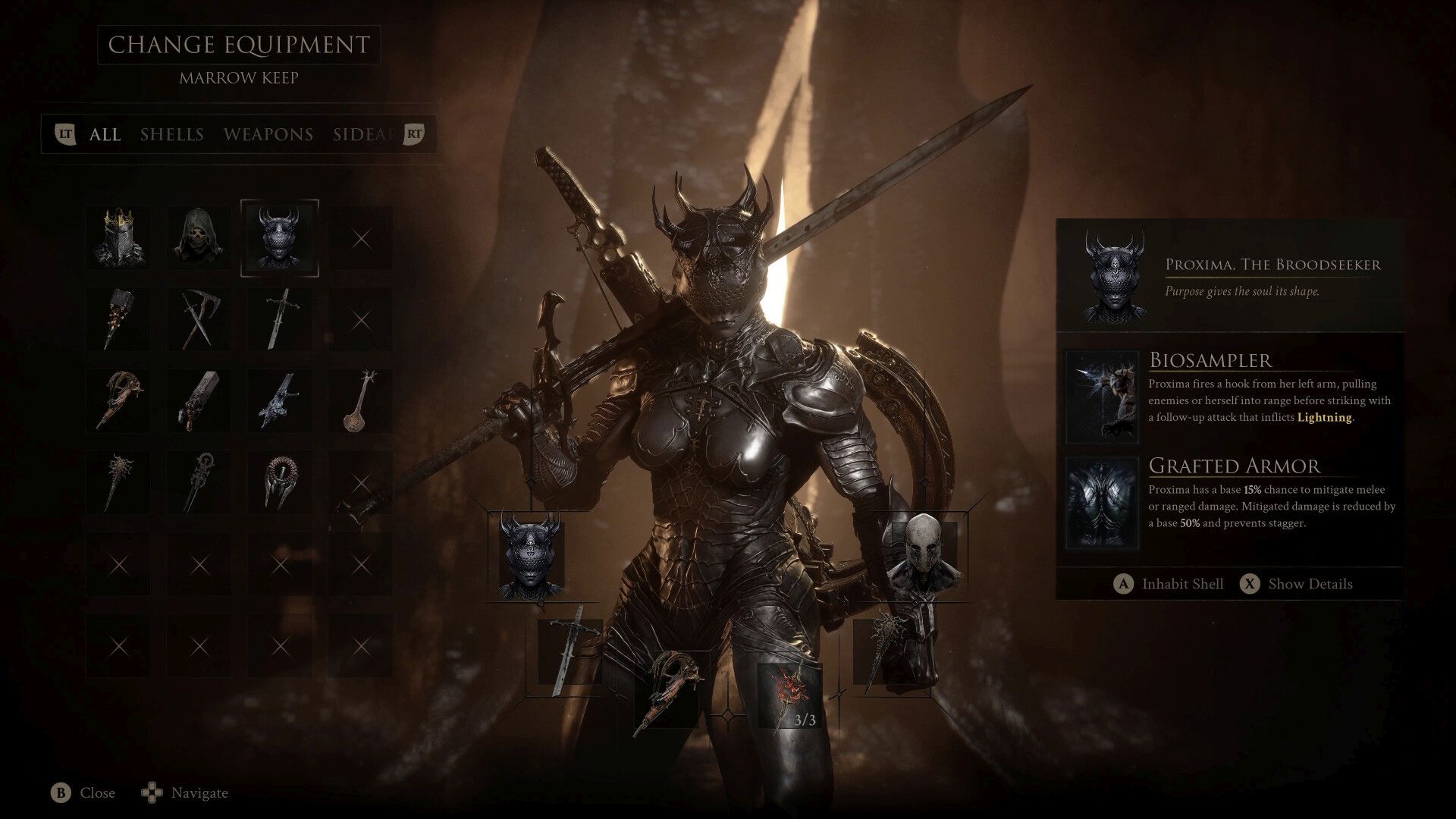
In Mortal Shell 2 — like in the first game — the player character is essentially a skin suit until they inhabit a shell. Shells are made from the armor and abilities of fallen warriors, so they function as both classes and armor sets. Each of the game’s eight shells comes with different stats and a special ability. For example, Proxima has a needle-like finger weapon that has several potent uses like a lightning charge. Shells level up separately from the base character in a couple of different ways. You can increase your bond with the shell, which strengthens its use as armor. Second, you can increase the Shell’s abilities and some passive stats.
During combat, when your character runs out of health, you’re knocked out of your shell, leaving you vulnerable though still able to use weapons and their abilities. In the first game, you had to hunt down your shell. In Mortal Shell 2, you regain your shell through melee combat. You can run through the cycle a number of times, but each time the shell becomes less effective and harder to regain. As in any other action RPG or Soulslike, you’re preferred gameplay style will fit one or two shells better than the others. Even if you do manage to unlock them all, resources are scarce enough that you’ll only be able to fully upgrade a few of them.
Never Run Out of Stamina Again
The original Mortal Shell — like nearly every other Soulslike — included stamina management as part of combat. Mortal Shell 2 entirely eliminates the stamina stat, so you can potentially block, parry, and attack constantly without worrying about running out of stamina. In its place, Mortal Shell 2 uses Resolve, which is used to power special attacks and is the ammo for ranged weapons. You fill the Resolve meter through melee combat, encouraging a consistently aggressive approach to battles.
Parries and perfect parries are the name of the game. There are Seals which can modify the timing and effectiveness of parrying. There’s also a Seal that replaces parries entirely, substituting a powerful attack that nearly always staggers an enemy. Using the Slayer’s Seal is as close to a difficulty slider as the game comes. There’s also an item to switch to a harder difficulty

The Shell and Resolve mechanics are probably the most significant deviations from the Soulslike formula. Nearly every other mechanic is some variation on familiar ideas, albeit with new, sometimes arcane terminology. There are different upgrade currencies and materials for melee and ranged weapons, and Tarstones, which add buffs, defenses, or coatings to weapons. By design, a lot of Mortal Shell 2’s mechanics and items aren’t necessarily explained. The downside to this intential opacity is that players can miss key items or neglect upgrades they didn’t know they could make.
A World Apart
Mortal Shell 2 expands from the small and linear environments of the original into a densely layered, interconnected open world. The difference in scale is staggering. The first game focused on a darkly gothic design almost exclusively. Of course, a great many locations in Mortal Shell 2 are desaturated, fog-filled and decrepit crumbling ruins, forts, and castles. But there are more verdant spaces, too. Overall, there’s far more visual variety this time around. Unfortunately, not every area feels organic or like it’s anything more than a stage for combat or a particularly grindy gauntlet to the next checkpoint. While most of the environments are interesting to explore, there’s also a “Soulslike greatest hits” element when it comes to design.
This brings me to one of Mortal Shell 2’s minor frustrations, pacing. The game absolutely embraces the original Dark Souls’ “two steps forward, one step back” progression loop. The placement of enemies and the distance between Beacons (until you find and unlock shortcuts) can make repeated runs feel a lot like work. A better map and a compass on the screen would help. For better or worse, games like Elden Ring have made us forget what inching forward felt like. This is a particular problem in the game’s first few hours.

Mortal Shell 2 has dozens and dozens of large and small dungeons to explore. Some of these are beneath the many fog walls out in the world. The game’s Beacons (checkpoints) also have associated dungeons. Some of the dungeons are bite-sized but many others are surprisingly large and complex. Many contain puzzle elements. All of them have a useful reward, be it a new weapon or upgrade material. While assets and design elements are reused, I nearly always enjoyed the dungeons and their challenges
Shocking
We haven’t discussed Mortal Shell 2’s narrative, which is only tangentially related to the first game. You play as the Harbinger and your task is to collect ova, stolen from the remains of the Undermether, a powerful alien deity. The corrupted power of the stolen ova has fueled the rise of false prophets, cults, and monsters. By collecting the ova, you return the world to order. It’s a weird, twisted story that resonates with a lot of world mythology and is perfectly in sync with the art style and level design.
Also in harmony with the art and narrative is the game’s environmental and combat audio, as well as some fairly sparse voice acting, all of which are solid. While exploring, the game’s music is extremely minimal, usually consisting of sustained, often discordant, orchestral, processed or vocal sounds. Boss music is, sadly, kind of forgettable and lacks the strong identity that the rest of the game embraces.
While the team size increased for Mortal Shell 2, Cold Symmetry is still a relatively small developer and the technical achievement of their second game is all the more remarkable. Still, there are bugs that need to be addressed. I had no outright crashes, but sound dropouts and getting stuck in level geometry was fairly common.
A Must-Play for Genre Fans
Mortal Shell 2 is such an immensely impressive upgrade from the original that I wanted it to be flawless. Of course, it isn’t. However, issues with pacing, opacity, occasional difficulty spikes, and bugs are dwarfed by Cold Symmetry’s overall achievement. If Mortal Shell was a short story, Mortal Shell 2 is a richly textured epic novel. The Shell System has been fully realized. The shift from stamina to Resolve pushes combat towards relentless action and risk. If Mortal Shell was an appetizer, Mortal Shell 2 is a full, satisfying meal and should be in the library of every Soulslike fan.
***PC code provided by the publisher for review***
The Good
- Impressive level and open world design
- Excellent combat
- Innovative mechanics
- Challenging but (usually) fair fights
The Bad
- Progression can feel slow in places
- Some bugs
- A few zones are undercooked
- Needs a compass