Valor Mortis Review
Not too many years ago, “Soulslike” meant a dark fantasy, third-person action RPG with certain mechanics cribbed from FromSoftware and classic Metroidvanias. That’s no longer entirely the case. There are Soulslikes that are entirely 2D, or first-person. The settings can range from dark fantasy to ancient China, far future sci-fi worlds or 18th-century Europe. Valor Mortis, from the developer of Ghostrunner and its sequel, brands itself a Soulslike. In some ways, it absolutely is. In others, though, it feels closer to BioShock. All games are amalgams of other games, of course, but one of Valor Mortis’ strengths is that come across somewhat unique despite its influences. That doesn’t necessarily translate to entirely successful.
Napoleon Complex
Valor Mortis joins Soulslikes like Steel Rising and Lies P in setting its action in late 18th/early19th century Europe. You play as William, a British soldier serving in Napoleon’s army. After dying in battle, you’re resurrected to find you have supernatural powers thanks to the Nephtoglobin plague, and the literal voice of Napoleon is in your head. As plagues do, they have ravaged the countryside and turned Napoleon’s soldiers and citizens into bloodthirsty monsters. Your tasks are to piece together the mystery of your resurrection and the role Bonparte played in the Nephtoglobin plague.
As with so many games in the genre, Valor Mortis’ narrative tends to be overshadowed by moment-to-moment action. Throughout the game William meets a number of ally and enemy NPCs that help propel the main story forward. There are some minor side quests as well. Unfortunately, these often feel like a lot of work with little payoff. They do encourage exploration, of course, which is probably the main goal. Like many Soulslikes, areas in Valor Mortis are filled with shortcuts that are opened after fighting through them.
Speaking of exploration, there is no map or compass in Valor Mortis, asking the player to rely on memory and landmarks. The lack of objective markers leads to organic and thorough exploration. But sometimes it results in a lot of wasted time. There were several areas of the map I had to clear multiple times, only to realize that the object I needed was in another zone entirely, or that I missed some minor nook or cranny. Valor Mortis features a growing set of tools for exploiting the environment. That means in true metroidvania style, some areas are initially locked. Sometimes it feels like Valor Mortis doesn’t entirely know what it wants to do with its movement and parkour. The game will go heavy with it for a while, then spend hours forgetting it exists. And a warning: parkour in first person can be motion sickness-inducing for some.

The In the Heat of Combat
Combat is at the heart of Valor Mortis. Combat is where the game is strongest, but it’s also where its frustrations lie. Structurally, combat rises from classic Soulslike mechanics: heavy and light attacks, dodges, blocking, parrying and stamina management. William has melee weapons — including swords and rapiers — and ranged weapons like pistols and rifles. Additionally, there are magical powers. Called transmutations, these allow William to cast fire or supernatural barriers, slow down time or use a magical grapple, among other abilities.
So far, so good. When combat is flowing from melee to ranged attacks, from parries to magic, it can be exceptionally engaging. However, William very slowly acquires new weapons or skills, so the player will spend a lot of time with a small number of tools, underpowered and at a disadvantage. Some ARPGs are a power fantasy, and some focus on simply surviving. Valor Mortis is firmly in the latter category.

Players used to Soulslikes with endless sets of armor, magic spells, weapons or stats will find Valor Mortis’ approach very narrow. Everything is slow moving, including player progression and acquisition of healing items, which never seem to catch up in number. To a small extent, this is countered by the game’s version of Bloodborne’s rally system, where counterattacks earn back a small amount of health. The game’s upgrade paths for weapons and skills is not expansive, which perhaps explains why the game is in no rush for players to move players through it.
The Shift to First Person
Valor Mortis is a first-person game, which of course means that Soulslike players need to learn a new movement vocabulary for dodging, parrying, and attacking. This could be fantastic, but in this case there are a lot of frustrations. Combat animations are clunky, and hitboxes are wildly inconsistent, both when attacking and defending. This is particularly annoying when it comes to ranged weapons, where the player’s gun occasionally does little damage at close range, but an enemy’s rifle shot connects from the other side of the map. Judging the parryable range of sword or rapier attacks never felt entirely reliable.
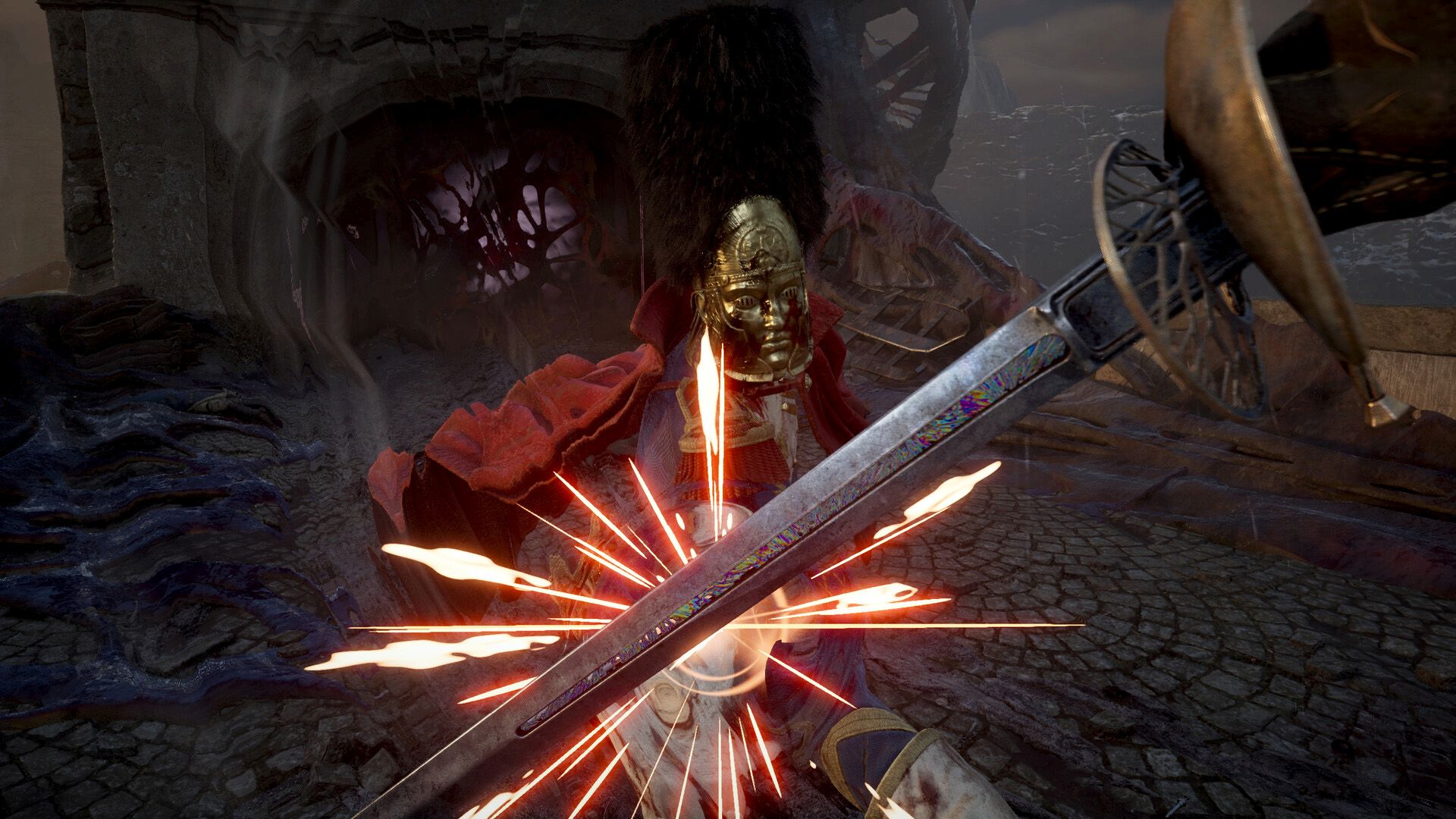
When it comes to enemy design, there are plague-ridden soldiers, automaton-like creations and a host of monsters in various strengths and flavors. Valor Mortis is full of gauntlet-like passages — a Soulslike staple — and bosses that focus on a particular skill like parrying. The game’s first proper boss, General Lothaire, is hands-down the most tedious and unbalanced early boss I’ve encountered in a long time. However, I was pleased to note that Valor Mortis follows the lead from Lies of P and The First Berserker: Khazan. The players Catalyst (i.e. Souls) are waiting outside the boss room after defeat. Each run at the boss even earns a bit of XP.
Pretty, Grim
It’s easy to appreciate Valor Mortis’ Unreal Engine 5 graphics, which are sharp, detailed and evocative. There are some excellent weather and lighting effects and some unique environments. Character design for the game’s cast of NPCs is less impressive, though the voice acting is uniformly good. Although it gets a little repetitive, the music does a good job of altering the player to combat situations. While I didn’t have too many issues with framerates or optimization, I did have problems with getting stuck in geometry and inconsistently unresponsive controls.
Skilled players will probably take around 20 hours to breeze through Valor Mortis, but I would estimate closer to 30 for less skilled players or those wanting to find everything. The game’s lack of build variety works against multiple replays, however. Finally, the devs have noted a day 1 patch will address some of the balance issues noted in this review.

When it clicks, Valor Mortis is proof that a first-person Soulslike can succeed. The game’s setting and story help it stand out, and the flow of melee, ranged, and magic combat comes together at least some of the time. Imprecise hitboxes, clunky movement, and frustrating difficulty spikes are real issues, though. Slow player progression and a lack of direction can make the player feel stuck for extended periods. Better balance and more gratifying progression would help Valor Mortis become a must-play Soulslike.
***PC code provided by the publisher for review***
The Good
- Interesting setting
- First person twist on Soulslike ideas
- Enjoyable combat, mostly
- Sharp graphics
The Bad
- Balance and difficulty spikes
- Clunky movement
- Very slow character progression
- Limited build variety