Metal Eden Review
Developer Reikon’s 2017 twin-stick shooter Ruiner was a grim dark, Blade Runner-esq third person action game. It demonstrated that the studio had a talent for sci-fi world-building and compelling action. Now, Reikon has returned with Metal Eden. It’s a first-person shooter that’s as bright and shiny as Ruiner was moody. Though it inhabits a different world and fiction, Metal Eden shares many of Ruiner’s strengths, and maybe a few minor weaknesses as well.
A Whole New World
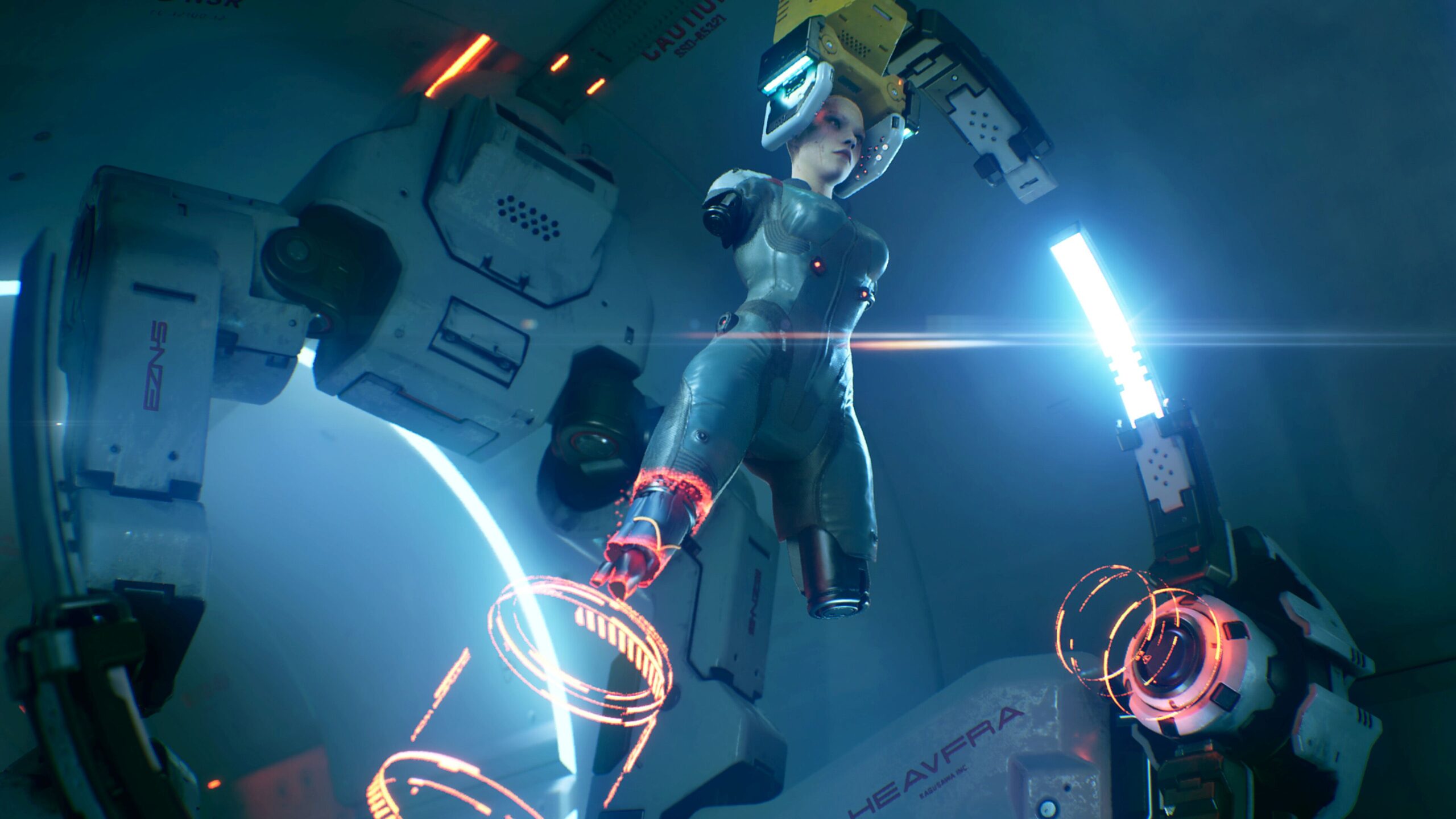
Although it sounds like the title of a prog-rock album, Metal Eden has an interesting, hard sci-fi premise. Earth has gone to hell and is uninhabitable. Human psyches have been digitized and recreated as biomechanical androids, living in a floating city called Moebius above an inhospitable mining planet called Vulcan.
Speculative fiction teaches us that something always goes bad with technology. In this case, a computer virus called the Erosion infects the colony, turning its paramilitary defense force into mindless husks. A group of powerful Engineers uses the husks to control the colony, essentially keeping everyone prisoners.
You play as a female android named Hyper Unit ASKA, and your task is to infiltrate Moebius, eliminate the Engineers by taking their Cores, and free the prisoners. There’s quite a bit of depth to the narrative and a number of mysteries around Moebius to be solved. For a shooter that’s essentially non-stop action, the story is relatively engaging.
The CORE of combat
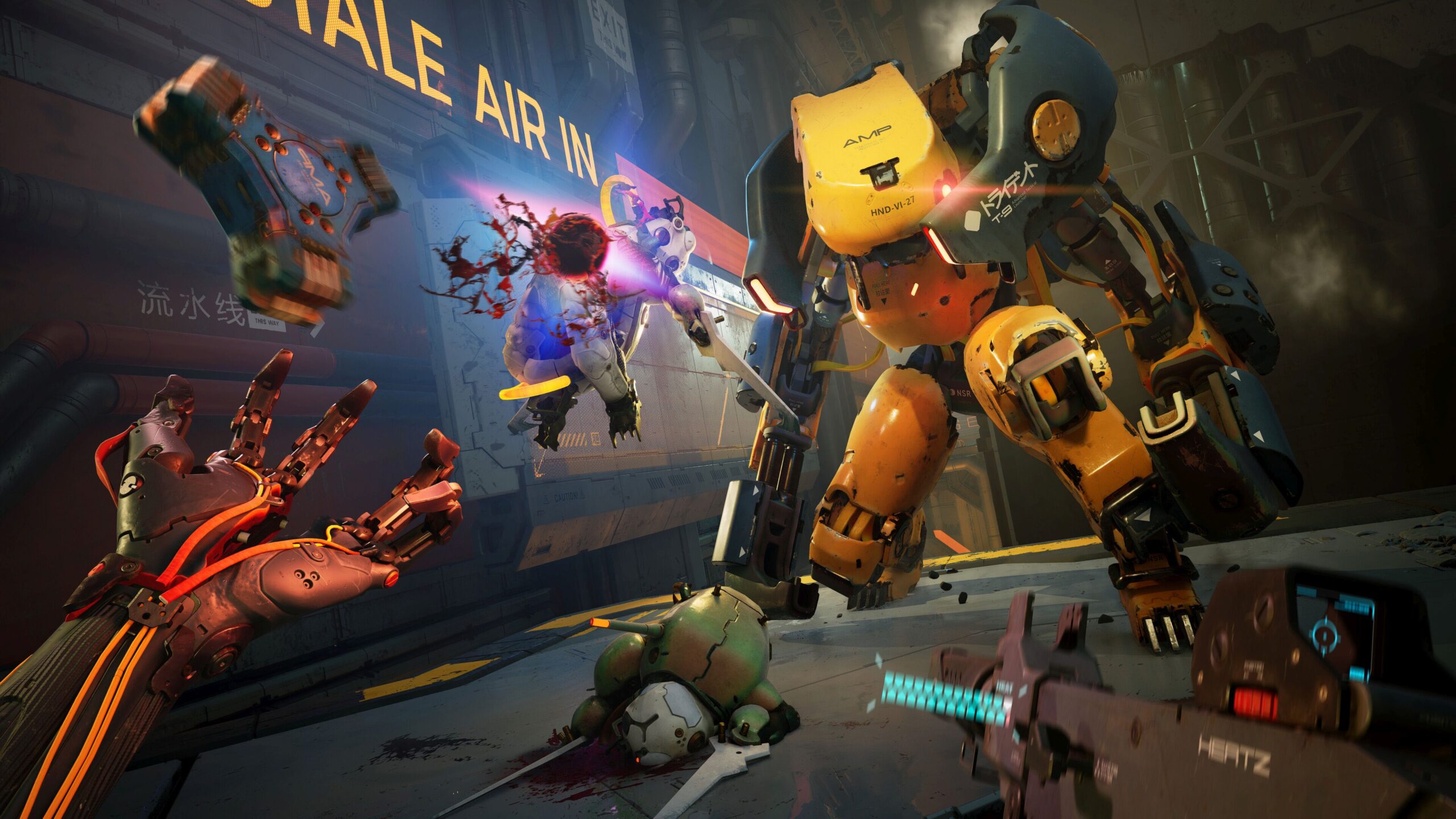
When it comes to describing Metal Eden’s game play, Doom meets Ghostrunner is a pretty good start. The game pairs visceral combat with extremely fluid, agile movement that develops in complexity throughout the game. Metal Eden is an almost entirely linear run through eight missions. While each mission has a similar structure and pace, there’s variety in environments, objectives and tools.
A typical mission will send ASKA through a series of relatively compact combat scenarios. Some are wave-based, while others simply require clearing the area of enemies and moving on. The mission ends with a boss, usually a frantic fight with both lower-tier enemies and a more powerful foe. Metal Eden does a good job of introducing a steady progression of enemy types in tandem with ASKA’s growing abilities. They all have speed in common. Metal Eden never allows the player to simply stand in one place.
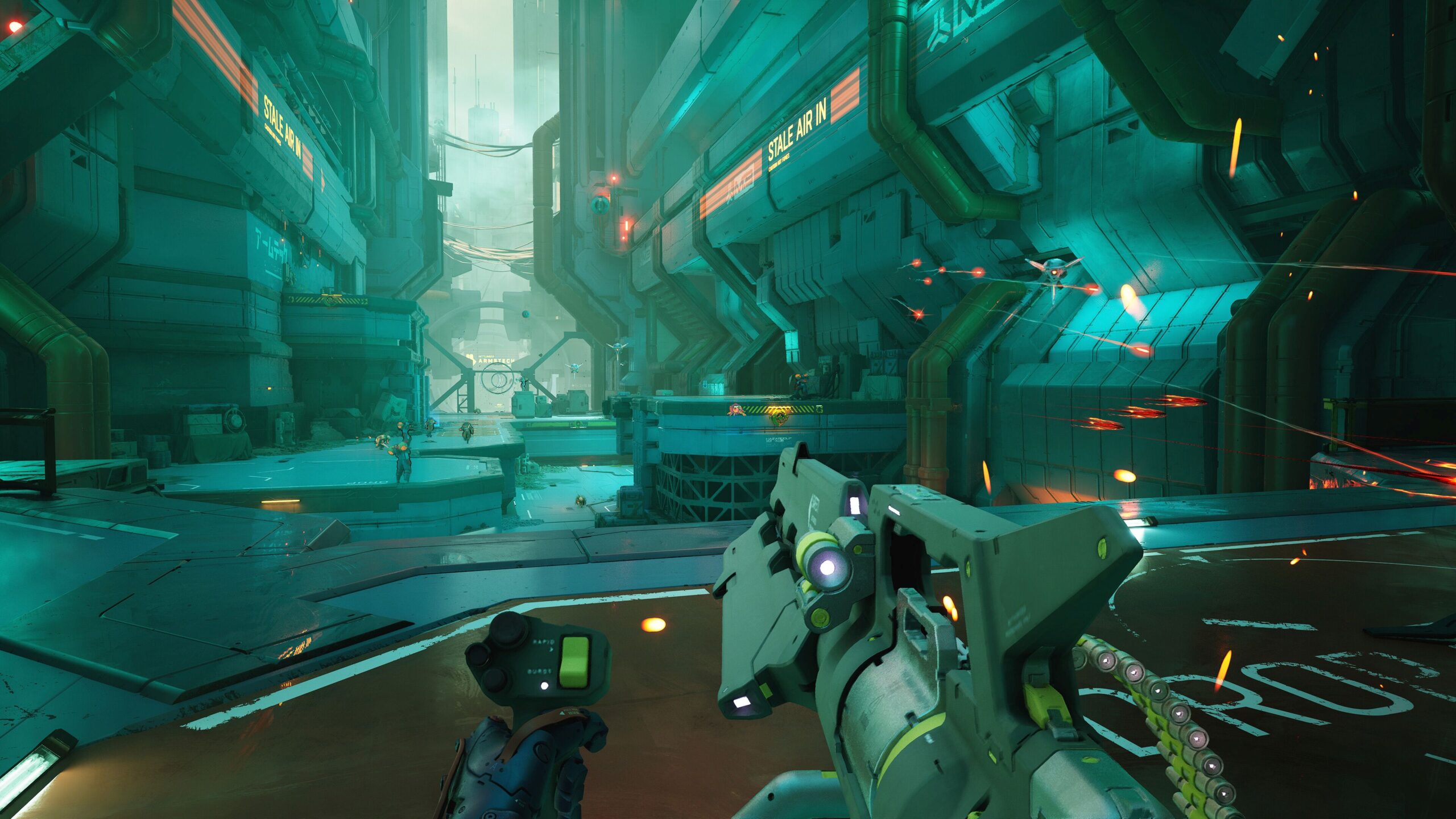
There are a number of subsystems supporting combat. There are six basic weapon types, ranging from plasma rifles to shotguns, pistols and SMGs. Each have main and alternate firing modes, and players can freely and quickly switch weapons via a radial wheel. Metal Eden leans into a rock-paper-scissors relationship between enemies and weapons, encouraging frequent weapon swaps. There are a couple of currency systems at play facilitating weapon upgrades and new abilities. Metal Eden doesn’t do a great job of explaining its XP system.
Heal Me
What I’ve described so far applies to 99% of first person shooters, but Metal Eden has some interesting tricks up its cybernetic sleeves. First, ASKA heals primarily by ripping out an enemy’s Core, which in humans uncorrupted by the Erosion would be their neural network. Enemies, however, have Cores that are essentially part of the hive mind. ASKA can use an enemy’s core in a couple of ways. She can consume it to retrieve health, or use it to attack an enemy. Naturally, purely mechanical enemies can’t be exploited for their Cores, until ASKA breaks their armor.
Early in the game, ASKA learns the ability to transform into Ball Form. She becomes a little spherical armored vehicle, able to shoot electrical charges and miniature homing missiles. Ball Form is key to certain environmental challenges and defeating enemies that are otherwise resistant to ASKA’s regular attacks. It soon becomes second nature to jump between ASKA’s regular android form and Ball Form.
Finally, and maybe most critically, Metal Eden’s environments are a playground for running, jumping, wall running, ziplining, grappling and rolling. Metal Eden revels in fluid movement and by and large, it feels pretty good. The game does an excellent job of introducing each new movement type and then creating scenarios that demand its use. When it all comes together, combat and movement feel very effortless and organic.
Angles and Reflections
Ruiner was set in a gritty, Cyberpunk world that was profoundly bleak, both emotionally and visually. Metal Eden is about a shining high-tech utopia floating above a planet, so it is filled with sharp angles, reflective textures and vertiginous structures reaching to the sky. Ultimately, the indoor environments can’t escape their utility as video game combat arenas, and the Vulcan landscape looks a little undeveloped, but overall, Metal Eden’s graphics are impressive. Equally high caliber are Metal Eden’s sound design and music.
It should be noted — and the developers are upfront about this — that some voice acting is AI generated. However you feel about this, at least there’s context for this decision in Metal Eden, where virtually every character is in part digital.
On my Ryzen 9 and 4090, the game ran in 4K at a solid 120fps. I had no issues, aside from being fairly incompetent when transitioning from jumping into wall running or changing zip lines on the fly. But those probably are on me.
Metal Eden is a satisfying shooter, but it isn’t perfect. A few of the combat animations, like punching and absorbing ripped Cores, have a bit of input lag. The game also relies pretty heavily on a mission structure and pace that doesn’t vary much. There are also some stretches of interior and planet-side environments that feel a bit like filler.
Laser Focused
Metal Eden is free of mission creep, focusing on refined movement, breakneck speed and punchy combat. It does those things well, embedded in an interesting fiction and shiny cyberpunk environments. A few objectives and systems aren’t always clear, and the game’s linear design and rigid mission structure could use some breathing room, as it starts to feel a bit repetitive. All in all, Metal Eden is a fun, fast and furious sci-fi shooter and will definitely appeal to fans of the genre.
***PC code provided by the publisher for review***
The Good
- Fast, furious combat
- Engaging parkour and movement
- Impressive environments
- Interesting story premise
The Bad
- Fairly rigid mission structure
- Very linear
- A few loose controls
- Some opaque objectives