Dread Meridian VR Review
Dread Meridian is an original Lovecraft-inspired VR survival horror adventure game from developer KUKRGAME. You play as Daniela, a researcher who ventures to a remote Arctic island in a desperate search for her missing twin sister, Isabella. Once you reach the frozen wasteland of Oglanbyen inspired by Lovecraft’s “At the Mountains of Madness,” the adventure begins. You will scavenge for resources, solve cryptic puzzles, and battle unimaginable creatures while unraveling the mystery of her disappearance. You must withstand the terrors of Oglanbyen so you can solve its mysteries and find your sister.
My first experience with the game was with the beta version of the game. It did not make a good first impression. Based on the beta, the game would get a failing grade. It became very clear that the game needed a lot more development time. This is further borne out that since launch, the game has received six updates in the first eight days! These are all hefty updates. They mostly deal with logic fixes and optimization. It is sad to say that while this version of the game – V1.0.0.6 – is now playable it is still far from an enjoyable experience.
In this crowded gaming marketplace, a game only gets one chance to make a positive impression. Only a handful of games have been able to overcome the initial deficit of negative launch reactions. No Man’s Sky is the best example, but it is an outlier. Nearly all games that release too early sink into obscurity. It’s one thing if a game is not good, but it’s heartbreaking when one has easily seen positive qualities. Alas, Dread Meridian falls into the latter camp. As a devout lover of horror games, especially those in VR, it saddens me to see a game with such promise scuttled.
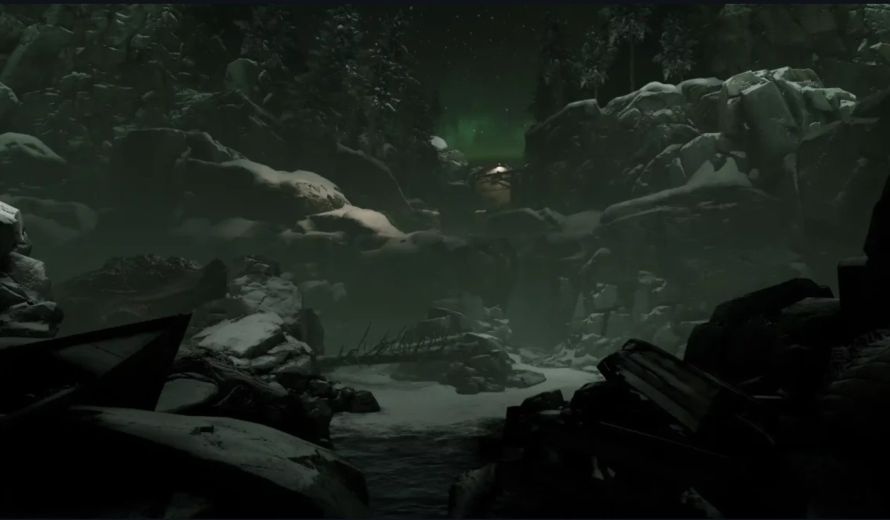
Dread Meridian impresses in so many ways. Early in the game, after you leave your shipwreck, you work your way into the interior searching for shelter. Snow and ice cover the nighttime landscape around you. Blowing snow whips around you. You can hear wolves howling in the distance. At the top of the ravine walls, you see a forest of pine trees, their branches swaying in the wind. It’s a beautiful moment accentuated in that immersive way that only VR can deliver. A wonderful game world setting moment.
Undercut by Technical Issues
Unfortunately, technical and visual issues quickly diminish the immersion of that moment. Before detailing issues, let’s look at the positives. On the all-important game audio, vital in a horror game more than any other genre, Dread Meridian has a more than competent library. The music score reacts to the gameplay. When need be, it delivers arrangements that heighten the tension. Also effective are the weapon sounds. Graphically, the game has a striking and distinctive look meant to capture the look and feel of the 1920s-30s era. Each area of the game is full of detail, with excellent lighting and shadow effects.
However, the level of detail is a double-edged sword. There is a strong temptation to interact with all the objects on display, but you cannot. The amount of interactivity is a telltale marker that this is an indie game. The game limits interactive objects to those that are necessary. You can pick up recordings, cleverly designed as wax cylinders you use with a phonograph-type device. A nice switch from cassette tapes or other more modern day storage media. There are also documents to collect that relay the game’s lore. It is frustrating when you can’t pick up an obvious weapon, say an axe, unless the game designates it as such.
While the game is based on Lovecraft lore, the game design is straight out of previous horror games. Fans of the Resident Evil or Silent Hill games will recognize cribbed scenarios. The problem is that those aforementioned games have controls that are tight and responsive. Everything in this game is so clunky. The evil doctor in the early island section moves too slowly and only feels like a genuine threat because of the janky controls. Everything feels slow, loose, and unconnected to what is happening in the game. It’s like moving underwater. Hit detection on enemies is imprecise and not communicated well. Grabbing a firearm is hard enough, but trying to reload and cock the weapon during combat is an exercise in frustration.
The game’s potential enjoyment continues to dissipate when you combine janky weapon handling with a clunky inventory system. Using the inventory system is a handful. Initially, inventory handling looks promising as it uses the popular VR mechanic of a backpack, like the excellent one in Metro Awakening. Where the implementation falls flat is in the UI. Instead of obvious tap points or buttons to press, the hit boxes are above them. This design causes the player to make mistakes, and turns into a guessing game of to interact with a desired item.
Design Deficiencies
The game also has a hobbled version of weapon placement. Normally in VR games, your major weapons are on either hip, usually a pistol and a knife. Players draw other weapons from either shoulder. The game only has two extra weapons available: the submachine gun and the shotgun. So instead of being able to draw from either shoulder, you must cycle between the two weapons on one shoulder. How annoying this design decision is depends on how well you can handle the aforementioned weapon jank. You might just end up using the knife only. It is easier to use and, intentionally or not, nets you multiple hit points. The only time you really need your weapons is during boss battles.
Similar design deficiencies spring up for the health, diary and weapon upgrade aspects of the game too. The game displays health on a wristwatch, but with no markings, players cannot determine their full health. The diary contains objectives, but they are often incomplete and lack clarity of direction. Some directions come from radio conversations, but if you don’t write them down, you are apt to forget them. Weapon upgrades are available by collecting Weiranium material. You use this material with an upgrade machine, but the machine only allows one use.

Compounding all these gameplay issues are a myriad of technical ones. Sound cues stand out, especially with overlapping ones. Quite annoying, especially when it happens during dialog with multiple characters. Also, the dialog and character lip movements are often out of sync. Volume levels also fluctuate or cut out altogether. The game does not load environmental textures properly on the visual side, requiring a restart. Another immersion-breaking issue is how erratically scripted events occur. Often they trigger too early. Despite all the updates, logic issues still persist. One example is where you need to mix some plants to make a perceptive altering potion. On my first attempt, I did so incorrectly. After my first attempt, any subsequent attempts where I did it correctly also failed. The only way to advance past this puzzle was to restart the game.
Developers and publishers, please, please heed these words. You only have one chance to make a good first impression. You are far better off delaying the release of a game that still needs more work. It’s understandable that you are under time and money pressures, but there must be bare minimum quality standards to be met. Players will forget the delays. Botched launches are forever.
A Dim Future
Dread Meridian may turn out to be a good, heck, maybe even a great game in time. The developers have been actively fixing bugs and releasing new versions. Good for them, but also proof that the game needed more development and testing time. In a crowded gaming marketplace, there are so many other games more worthy of your time and money.
If you’re a big VR horror or Lovecraft fan and this game has caught your eye, it’s best to proceed with caution for now. Follow the developers on Discord and keep an eye on player feedback. If sentiment starts to trend more positive, that’s the time to jump in. For Dread Meridian, the most terrifying thing attached to the experience right now may be its negative first impression.

***PC code provided by the publisher***
The Good
- detailed environments
- occasional immersive VR moments
- good soundtrack
The Bad
- many technical issues
- glitchy audio
- janky controls