Crimson Moon Review
I was pretty excited about Crimson Moon. Gothic art, action RPG combat, and a roguelike structure sounded like a winning combination. Now that I’ve played it, I’m just a little uncertain about how I feel. On one hand, I really liked what the art department put together. And while the range of enemy types is limited, so is the length of the game. There are some technical stumbles and a few limits on the fun. But for the price, Crimson Moon is a reasonable purchase for action fans, and it has a lot of potential as a platform for expansion.
Angel Eyes
Crimson Moon’s narrative is short on exposition and that’s ok, because it’s more of a premise than a story. You play as a Nephilim, the go-to half human, half-angel race so beloved in video game fantasy. The city of Gildenarch has been overrun by demons and your task is to clear out three districts, the low-level monsters and bosses within. Back in your home base cathedral, there’s a handful of vendor NPCs that toss a bit of lore, missions and bounties your way. You know, as long as you’re going to the store anyway, pick up some dinner, too.
There’s no character creator, but your face and body are always encased in armor, and you never speak anyway. This is a little disappointing. After all, not all Nephilim look alike. Or do they? I have no idea.
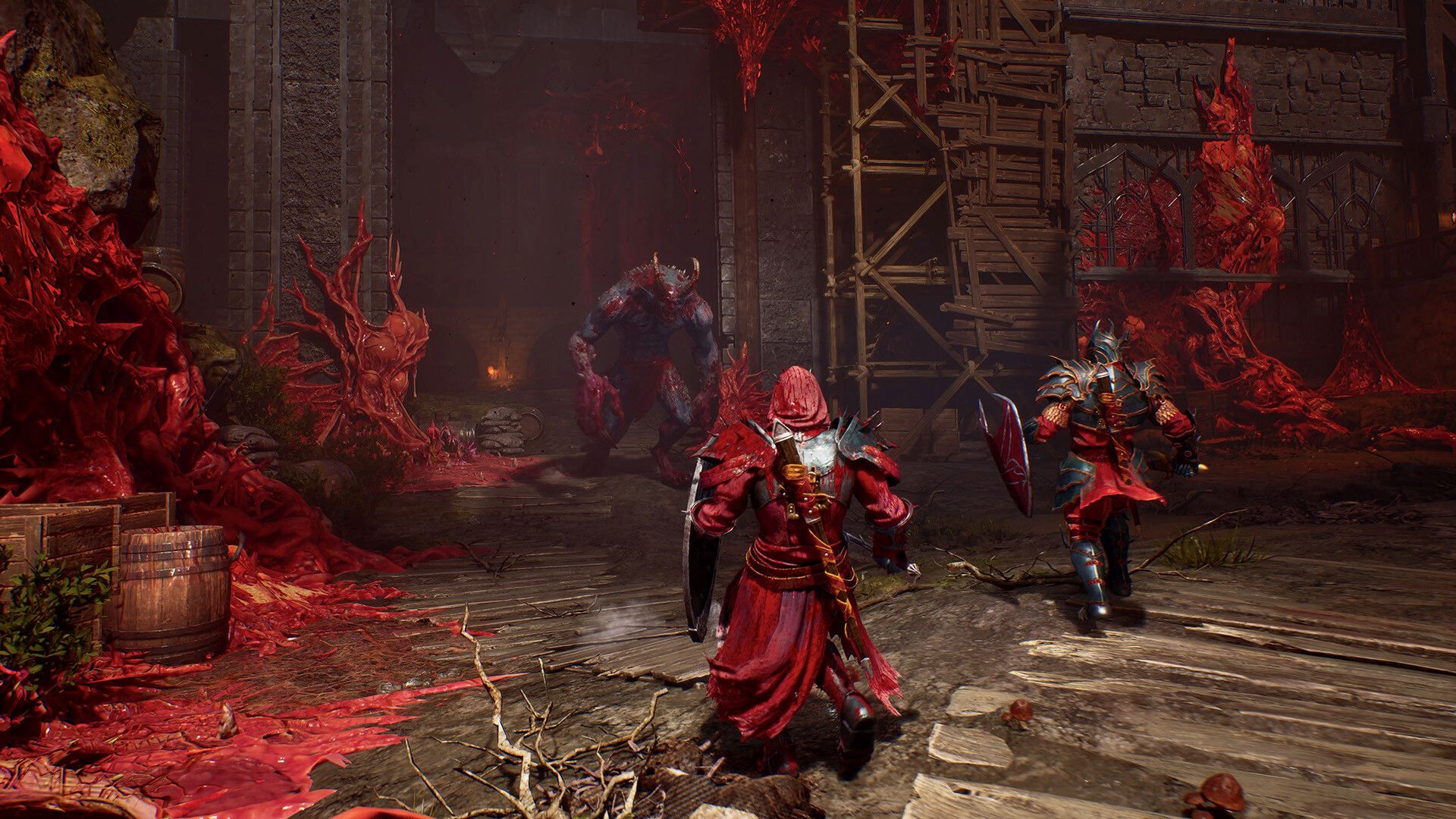
However — and this is a major hook — you have the potential for constantly swapping armor and weapons, so your appearance changes. You begin each run with a pre-configured load out, but enemies consistently drop weapons, armor, consumables and throwables. You spend a lot of time comparing what you’re rolling with against what you find. Weapons and things like shields have powers or buffs that can totally change your play style. This potential for an always-shifting approach keeps things interesting. Make it through the run and your newly obtained gear is purified and gets permanently added to your collection. You can also upgrade your favorite gear at the cathedral’s blacksmith.
The only counterargument to the weapon-armor swapping mechanic is that once you find a set that works, you don’t necessarily want to change. A single play through of Crimson Moon’s base campaign only takes 6 or so hours. However, the game encourages repeated plays at higher difficulties for better rewards.
Hacky and Slashy
Crimson Moon is not a pure Soulslike. You don’t have healing savepoints (though finishing up a section of the map refills your flasks), and you can die multiple times and carry on. However, the moveset repertoire is familiar: light/heavy attacks, blocks, parries, and dodges. You have an “angelic form” that makes you briefly extra powerful and invulnerable. Moment-to-moment combat feels pretty darn good, although the sound design defaults to the same ding for every kind of weapon. Elite enemies are no joke. There’s a pretty big gulf between the easy and more difficult settings.
Levels are divided into three segments, and at the end of each segment you select between three permanent boons (buffs). These stack, so by the end of the run you’re a decently powerful character. The various boons synergize well with different weapons, armors, and playstyles.

The biggest issue with combat right now is that the camera can be brutally uncooperative, swinging wildly around the action, especially in tight spaces. This is a common issue in action games, but maybe more of a problem in Crimson Moon in particular. If you’re a keyboard and mouse warrior, you’re currently out of luck when it comes to reconfiguring keys. It’s coming, we’re told, and in fact a beta version might already be in place. Aside from that, performance is smooth.
Viva Las Vegas
In its home-base cathedral, Crimson Moon features the most riotously detailed, garish, and visually dense structure I’ve ever seen in a game. It looks like the unholy marriage of a gothic cathedral and a Las Vegas casino. Unfortunately, the rest of the game doesn’t reach those audacious heights. The game’s colorful, slightly stylized, and attractive environments look exactly like what they are: gothic fantasy video game levels. Am I complaining? Only in the sense that we’ve seen these villages, rotting graveyards, dusty libraries and imposing churches many times before.
Crimson Moon’s sense of deja vu extends to its music, which like many fantasy scores, doesn’t quite know where to land stylistically. Composer Christopher Wilson starts with orchestral and choral textures and overlays them with metal guitars and drums. Listened to outside of the game, it’s pretty interesting. Inside the game, it sounds generic.

For what it is right now, Crimson Moon’s $20 price tag is entirely appropriate. I had a lot of fun with the game’s combat, which supports both solo and duo play. I can easily see developer Probably Monsters adding more levels, monsters, and gear. With a few patches to iron out the camera, Crimson Moon will be a solid choice for fans of fantasy action
***PC code provided by the publisher for review***
The Good
- Basically fun combat
- Interesting genre mashup
- Colorful art
- Balance of price and content
The Bad
- Camera issues
- Weak story
- Can feel generic at times
- Base game is very short