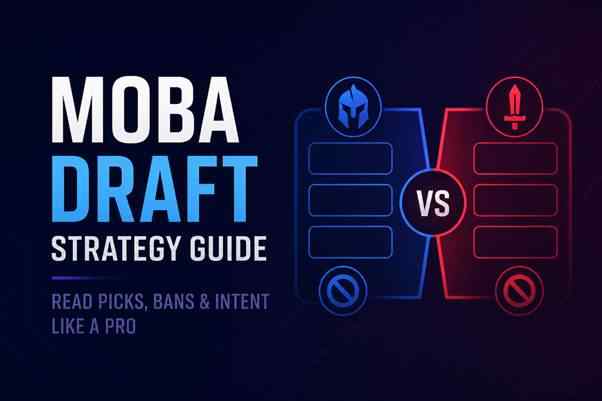
A great MOBA match comes to life before anyone last-hits a creep. A MOBA, or multiplayer online battle arena, is a team-based strategy game where players control individual characters, fight across lanes, secure objectives, and work together to destroy the opposing base. The draft is where teams reveal fear, comfort, tempo, and ego. One ban can erase a star’s best path into the game. One early pick can announce that the map needs to move fast.
That is why the draft phase deserves more attention from casual esports viewers. Research on MOBA expertise and fluid intelligence has linked high-level performance in League of Legends and Dota 2 with complex cognitive demands, which fits the way drafts work.
The Draft Is the First Teamfight
In League of Legends and Dota 2, a draft is a public negotiation between two versions of the same match. One team may want early skirmishes, strong lanes, and quick objective pressure. The other may prefer scaling, defensive wave control, and a cleaner late-game setup. Neither plan is automatically better. The real question is which plan holds under pressure.
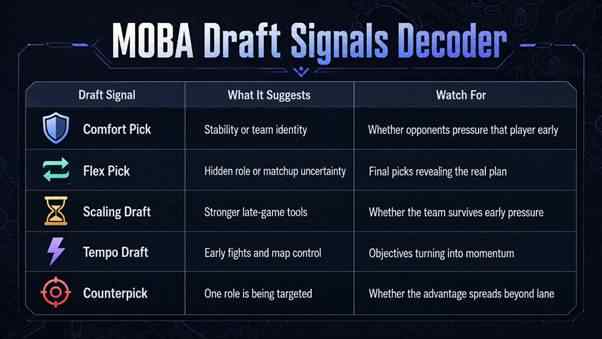
This is where spectators can start reading before the scoreboard exists. A ban can protect a weak matchup. A flex pick can hide a role assignment. A comfort pick can steady a player who defines the team’s identity. Drafting is not separate from action. It is the action in compressed form.
Reading the Match Around the Draft
Once a viewer understands that the draft is shaping the match, it helps to see those choices in a wider competitive setting. For example, esports betting at Bovada presents League of Legends and Dota 2 through match formats, fixtures, and market labels that sit around the games themselves. That context is useful because a draft does not mean the same thing in every series. A risky level-one plan in a single map feels different from the same idea in a best-of series, where teams can adjust, repeat, or punish patterns. Reading picks and bans beside the match structure also helps viewers understand why a team may draft for early pressure in one matchup and patience in another. Used this way, esports betting at Bovada works as a neutral context point for seeing how MOBA fixtures are framed outside the game client, then applying that framing back to the draft.
For a broader title-by-title view, BovadaHub’s guide to popular esports for betting places Dota 2 and League of Legends beside Counter-Strike, Valorant, and Call of Duty. That comparison is useful because MOBAs create tension differently from aim-heavy shooters. In a shooter, pressure often appears through sightlines, retakes, utility, and mechanical duels. In a MOBA, pressure may be quieter: a lane assignment, a jungle route, a delayed item spike, or a hero combo that becomes obvious later.
Why Picks Change the Emotion of a Match
A draft gives the match its first emotional shape. A scaling composition asks fans to work through discomfort. A tempo composition asks them to notice urgency before the lead disappears. A teamfight composition asks everyone to wait for one clean engage. A split-push idea creates a different tension, where the main event may happen away from the main camera.
That is why good analysts rarely talk about picks as isolated favorites. They talk about relationships. Does the top lane need help early? Can the mid laner move first? Does the support have initiation or peel? Is the jungle pick designed to invade, farm, protect, or unlock side lanes? The answers turn a draft from a list of names into a readable game plan.
The best drafts also create drama. Viewers know what a team wants before the players can prove it. If the composition needs the first dragon fight, that moment becomes heavier. If the late-game carry needs space, every early death feels larger. The draft teaches the audience what to care about.
The Hidden Skill Is Coherence
The most impressive draft is not always the flashiest. It is the one where the pieces seem to understand each other. Damage types, engage tools, defensive options, wave clear, objective control, and player comfort all have to fit. A lineup can have powerful individual characters and still feel awkward if nobody starts fights cleanly or protects the right target.
This is why draft mistakes can look invisible until they suddenly look obvious. A team may win lanes, but have no reliable way to start a fight. Another may have late-game tools, but no safe route to reach them.
For viewers, the reward is sharper watching. Once you can read the draft, the match stops feeling like random swings. You start seeing why a team groups early, why another avoids fights, why a support disappears from lane, or why one objective gets traded without panic. Team-based MOBA play depends on cohesion, communication, and role balance, a point explored in open-access research on group cohesion and team play in MOBAs.
What the Draft Teaches Viewers
The smartest way to watch a MOBA draft is to ask what kind of match each team is trying to create. Some lineups want short windows of pressure. Others want time, space, and cleaner late fights. That simple question turns picks and bans into story clues, rather than names on a screen. The draft is not a prediction machine. It is a lens. Once you can read that lens, every rotation, delay, and engage feels more intentional.