OPUS: Prism Peak Review
Opus: Prism Peak is Taiwanese developer SIGONO’s latest entry into their Opus series, which spans three other titles. While their previous titles took place in a more sci-fi setting, the focus on narrative, exploration, and puzzles remains. The aesthetics of Opus: Prism Peak are what drew me in, but the story kept me engaged and wanting to learn more about the characters and the world.
The game places you in the role of Eugene, a photographer in his early 40’s who is travelling back to his hometown for a funeral. While driving through a tunnel, he crashes his car, and upon exiting, ends up in the Dusklands. There, he encounters a young girl who has lost her memories aside from her goal of returning home to Dusk Mountain.
Stranded and without a way to return home, Eugene helps the young girl while discovering more about the Dusklands and finding his own way home. Throughout the story, Eugene encounters many talking animals with their own stories and struggles, as you continue to learn more about Eugene and how he ended up where he is in life. What starts as a simple, charming adventure turns into something deeper and full of mystery, nostalgia, and emotion
Powerful Comparisons
It’s easy to compare the game to a Studio Ghibli or Makoto Shinkai production, given the overall atmosphere and themes. I can see the similarities, but the important thing is that Opus: Prism Peak does a great job in presenting an engaging narrative that not only pushes the game forward but also encourages and rewards greater exploration. The game also features multiple endings, with decisions and the amount of exploration playing a role in what is unlocked.
The primary gameplay loops of Prism Peak revolve around exploration but feature elements of puzzle solving and utilizing Eugene’s camera to take pictures. Interacting with points of interest provides some context, but taking pictures of them provides more. Using the camera includes taking the photo, but it is supplemented by adjusting the exposure, focus, and filters. The game also has some mechanics that aren’t a part of the loop but are utilized in specific portions of the story. They are inserted seamlessly and are very effective.
Seeing is Believing
It is important to pay attention to dialogue as it helps Eugene to really see the world and its inhabitants. Most of the puzzles revolve around taking the right photographs and/or selecting the correct photographs or words to input. This is where paying attention and exploring help to learn the correct cues. There is no feeling in this game more disappointing than when it lets you know that you missed something.
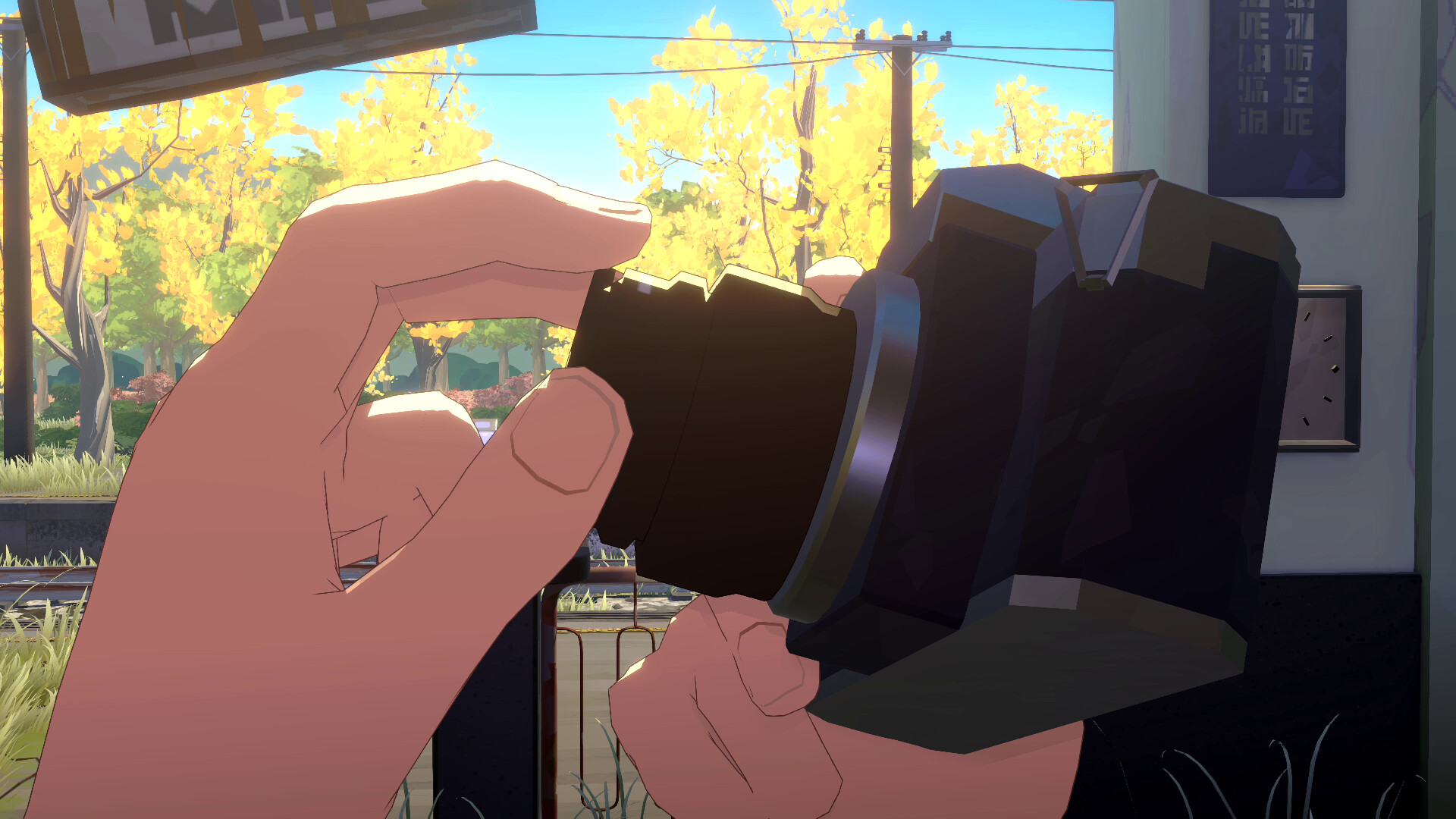
Where the game falters a bit is in its quality-of-life features. As the narrative is the primary focus of the title, it would have been nice to be able to pause during cutscenes. We all know that things can happen outside the game. Missing a few minutes of a critical cutscene is a lot, especially if the game autosaves after. At the same time, the game could also do with a manual save option. There were a number of actions I had to redo as the game did not autosave, even when I had expected it to. Though these are relatively minor cons, they were pretty noticeable as it affects the flow of the game.
Poetry in Motion
Overall, the art design of Opus: Prism Peak shines with its character designs, use of color, and beautiful vistas. Characters are unique and exude their own flair, while locations differentiate themselves in both style and tone. The game’s use of atmosphere helps to set the stage while the story fills the world. Gameplay-wise, the game distinguishes points of interest well, but blends them in to remain subtle. Additionally, the game’s audio is done really well. The voice acting is splendid. The soundtrack not only fits the game but also elevates it in certain instances to contribute to the overall atmosphere.
Opus: Prism Peak is SIGONO’s largest project yet, and the game delivers heavily on what it sets out to accomplish. Whether the game’s narrative resonates with you personally or not, it has a lot to offer in and out of the gaming space. The title’s narrative is at the forefront, supported strongly by its art style, gameplay mechanics, and everything in between. Prism Peak is an easy recommendation for anyone with an interest in narrative-focused games and will leave a lasting impression on me. Since beating the game, I’ve already gone back to fill out the rest of my notebook and collect the other endings.
*** A review code was provided by the publisher ***
The Good
- Beautiful aesthetic and atmosphere
- Insightful narrative
- Effective sum of all parts
The Bad
- Lack of a manual save option
- Inability to pause during cutscenes