Skytail VR Review
Skytail is an action-adventure game from developer/publisher Coatsink. Coatsink has a decent catalog of previous VR games such as Men In Black: Most Wanted, Augmented Empire, and Jurassic Park: Aftermath Collection to name a few. This time out, they have taken a heart-warming approach with Skytail. Think of a NeverEnding Story dragon rider rail shooter, and you have the essence of this game.
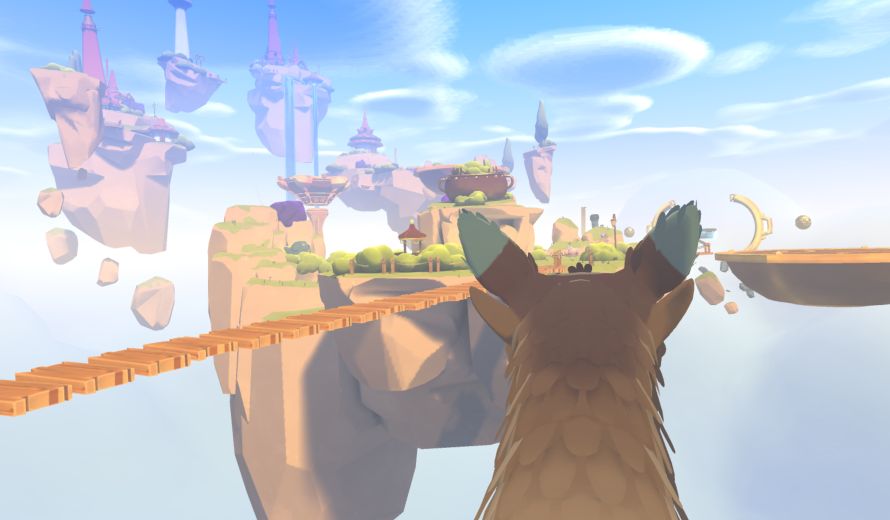
Skytail’s setting is that of the vibrant open skies of a fantasy world of an archipelago of small floating islands. Here you enjoy a peaceful existence, travelling from island to island on the back of Skytail, a massive bird-like companion. Alas, thieves stole her eggs, breaking the serenity you and your companion enjoyed. This sets you on a rescue mission.
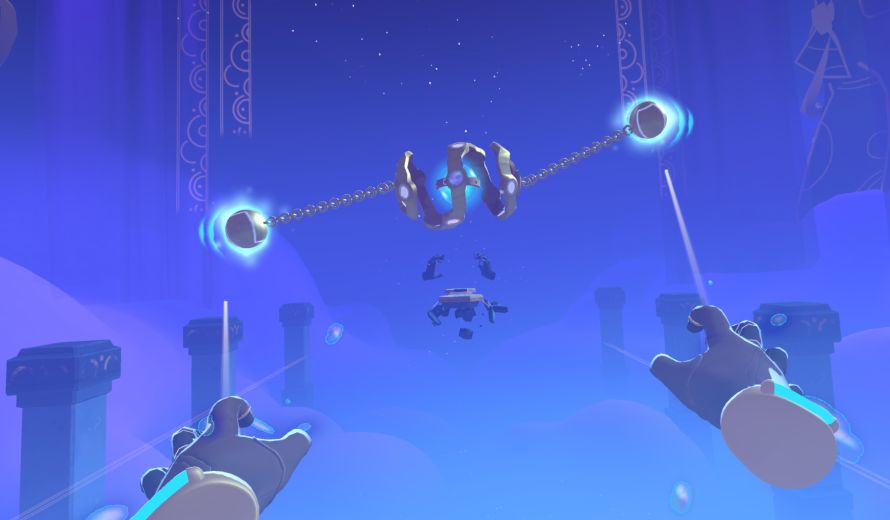
You must travel the islands in search of the stolen eggs, but said journey is fraught with danger. The sky lanes are full of blockades of corrupted enemies. To get past them, you must engage in combat. It is the combat that forms the core of the gameplay. You have telekinetic powers that allow for a variety of gesture-based attacks. You can grab, crush, and rip apart enemies, and you can launch charged objects as missiles against them.
Combat is also where the rail shooter aspect of the game comes into play. Your companion can only fly in a straight line. This design decision is certainly understandable because it simplifies the gameplay, but one cannot help but wonder how much more immersive this could have been with fully three-dimensional combat.
Engaging Combat
What makes Skytail’s combat engaging are the various enemy types and the combat tactics available to use against them. However, no matter new powers you gain, the core gameplay loop remains the same. You grab an enemy by pointing your controller at it and squeezing the trigger to grab it. Depending on the enemy type, you either crush it with a button press. Or you can keep squeezing the trigger to drag the enemy around and slam it into another enemy. You can attack shielded enemies with this action. Using enemies as projectiles provides immense visceral satisfaction.
Skytail combat allows for alternate methods of offense. You can create your own projectiles through gestures, or you can grab enemy fire and turn it against them. Again, the satisfaction you get when you turn their attacks against them is awesome. You can also supercharge all projectiles by moving them in rapid loops before release, which adds extra damage.
Skytail’s basic gestures for grab, move, and release, aka fire, all work well. They are easy to master and feel very intuitive. As you progress further in the game, more complicated gesture commands become available with more powerful commands, but here the game stumbles. They require more precision, and the time to pull them off increases, which interrupts the combat flow. And for me, the three basic commands worked well enough that I rarely called upon the more complicated ones.
The game introduces the expansion of your powers at a steady pace. Coupled with that, the enemy attacks, more demanding encounters, and the added powers come into play. This makes the basic commands intuitive through muscle memory. One additional power that also feels satisfactory is your shield. This is because you actually perform the blocking action through a gesture versus just pressing a button.
Skytail Lacks World And Companion Depth
The combat is the core attraction of the game. Combat actions based on gestures are the strength of an immersive experience that only VR can provide. The gestures provide such a strong visceral impact. Plus, they give an added depth to the gameplay as they allow for creative freedom in your tactical decisions. Should you crush an enemy outright, or use it to attack another enemy or block an attack? It becomes instinctive, and that is very gratifying.
Where the game stumbles are the areas outside of combat, the island hubs make for a welcome change of pace, but they feel undercooked. There is very little for you to do there. Some infections may appear, but crushing them deals with them quickly. The biggest miss is the relationship with your dragon-like companion. Rather, the lack thereof.

Beyond being able to pet her or cook food and feed her, there is nothing else to do. When in flight, the dragon locks into one position, further limiting interaction. All you ever see is her neck and the back of her head. If you look sideways, you can see her wings flapping. That’s it. She never looks back or makes any noise. When you think of relationships with similar creatures like in the movie The NeverEnding Story or a game with Trico from The Last Guardian PlayStation game, Skytail leaves you feeling empty.
From a production standpoint, the game is very well done. The texture-free presentation is a hallmark of standalone headsets like the Quest. However, their absence does not mean the game suffers graphically. The graphics have strong color work, especially in the sky sections, which make the game pleasant to look at without distracting the player during combat. Skytail’s art design supports the game-world rather than detracts from it. The audio in the game offers appropriate cues that align with the use of telekinetic powers. They add an oomph of extra satisfaction to the already fun combat.
Smooth Gameplay
The game also performs well with no noticeable stuttering. This is vital during combat. Even more so where the gameplay depends on constant movement and gesture-based combat. It’s a welcome change to play a game that bucks the recent trend of stuttery frame rates on the Meta VR headsets.
Despite a lack of depth, Skytail captured my attention with its core gameplay. The game uses the strengths of VR to immerse the player through the use of physical movement instead of button presses. You need to be physically active, but you don’t need to learn an overly complex set of gestures. The game starts with simple gestures that are good enough to complete it. The game also provides more complicated gestures at a decent pace, which are up to you whether to use them.
Skytail doesn’t reinvent VR gesture-based gameplay, or add anything new. However, what it does well is combat. Often, I would find myself sucked into playing it much longer than I planned. The game is fun to play and gives you a bit of a workout to boot. If that mix appeals to you, Skytail is worth your time and money.
***Meta game key provided by the publisher***
The Good
- Intuitive gesture-based combat
- Artwork complementary to gameplay
- Has that just one more level pull
The Bad
- Limited interaction with your Skytail companion
- Limited world building depth
- Not much to do on the islands