Source: Pixabay
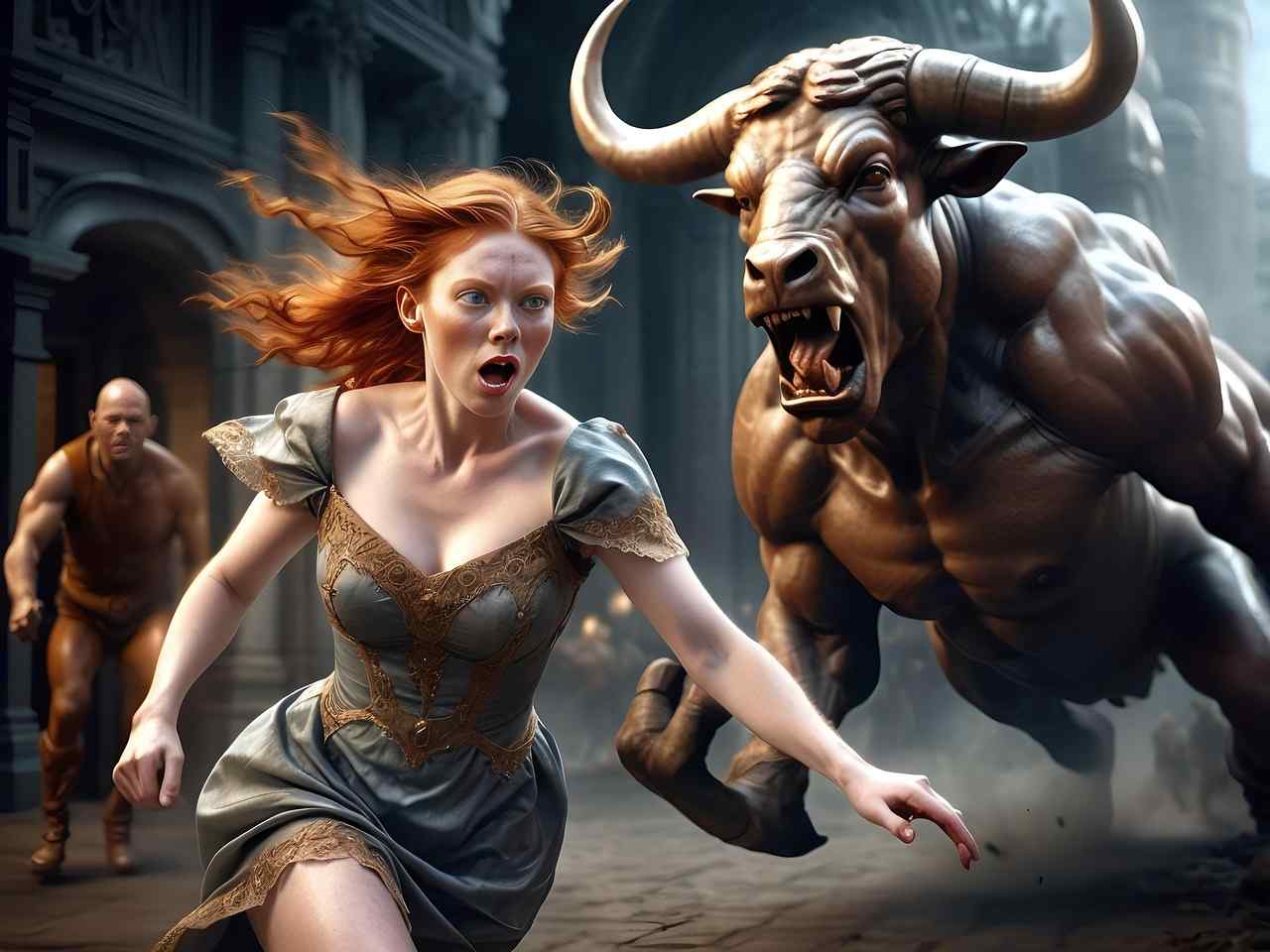
The Minotaur is a fearsome beast. Half-man, half-bull, it roams the corridors of an impossible labyrinth, hunting for helpless human victims to devour. An icon of Greek mythology, the Minotaur has long captured our imaginations, making appearances in modern films, TV and video games, where it is often portrayed as a brutal enemy to be defeated and overcome.
The Minotaur Myth
In Greek mythology, King Minos of Crete is given a magnificent white bull. Instead of sacrificing the bull as intended, he decides to keep it for himself. This makes the god Poseidon very angry. As a punishment, Poseidon makes Minos’ wife, Queen Pasiphae, fall in love with the bull.
In an unnatural union between the queen and the bull, Pasiphae gives birth to the Minotaur (yes, Greek myth can be very strange). Horrified, Minos orders the builder Daedalus to create a complex labyrinth to trap and contain the beast. Men and women from Athens are frequently sent into the labyrinth as sacrifices, where they are hunted and killed by the Minotaur.
Theseus, the prince of Athens, voluntarily joins a group of Athenians as they are sent to Crete to die. Before entering the maze, he is given a sword and ball of thread by Ariande, the daughter of King Minos. Thesus slays the Minotaur and then follows the thread back out to safety.
Minotaur’s Appeal in Gaming
The Minotaur myth has all of the aspects of a good story. We see human greed when the king keeps the prized bull, divine punishment when Poseidon steps in, then a heroic conclusion when Thesus finally defeats the beast using his courage and cunning.
This archetypal battle between good and evil, man and beast, has spawned dozens of adaptations across the gaming world, from table-top adventures to modern fantasy themed slots.
The slot game Minotaurus has a dark fantasy theme with an ominous orchestral soundtrack to capture the atmosphere of entering the labyrinth to face the legendary monster. The Minotaur is the main feature, appearing on the reels as an expanding wild symbol, which triggers a respin for even bigger wins.
Elsewhere in video games, the Minotaur is most often an enemy, usually a tough, aggressive boss blocking the player’s progress through a dank underworld environment.
Defeating the Minotaur
The Minotaur has been featured as an enemy in video games since the early days of 2D platformers like Castlevania, which expanded its Dracula theme by adding in other mythical creatures, the Minotaur included.
More modern appearances include Baldur’s Gate 3, where the Minotaur uses its Reckless Roar and Charge abilities to bring a physically challenging fight. In BG3, the Minotaur has a Mohawk haircut and sports basic armor, a nod to the human aspect of the beast’s nature.
In the God of War series, the Minotaur is presented as something of a mindless creature and its brute force is the emphasis. This traditional interpretation of the mythical beast has been brought back to life in the God of War: Ragnarok Valhalla DLC with modern graphics and very tough battle mechanics.
In Immortals: Fenyx Rising, Minotaur is a recurring enemy type, while the aptly named Nightmare of Daidalos, alluding to Daedalus, who built the labyrinth, is a stronger boss with a beautiful, colorful design.
Embracing and Expanding the Myth
The myth of the Minotaur is complete enough to tell a compelling story, yet open enough to allow game developers to adjust the portrayal of the creature and its background to fit their own mold.
In the classic RPG game Final Fantasy VIII, players enter the Tomb of the Unknown and experience a maze-like dungeon with puzzles and pedestals. At the end, they battle the Minotaur, who happens to have a little brother called Sacred. After defeating them, the pair can be summoned as ‘Guardian Forces’ to aid the player.
In the 2018 roguelike Hades, a game that is rich in myth and metaphor, the main character Zogreus encounters Asterius the Minotaur as he attempts to escape from the underworld. Here, the Minotaur stands side by side with Theseus as a dual boss. You may recall that Theseus defeats the Minotaur in the original myth, yet in death they are an inseparable team.
Assassin’s Creed Odyssey, which gives us one of the most visually impressive modern representations of the Minotaur as a legendary creature and challenging boss fight, also puts a wild spin on the myth. In Odyssey, the Minotaur was created by the Isu, an ancient, highly advanced race that was on the earth long before humans.
Emphasizing Brute Strength and Aggression
Let’s not forget that the Minotaur is not simply a mindless beast, as it is so often depicted. Being half human, it possesses some intelligence. It also spends its life roaming a labyrinth and so has excellent navigation skills.
To see these nuanced sides, we have to look back at the table-top game of Dungeons and Dragons, in which the Minotaur was a playable race. Aside from possessing the obvious strength and aggression traits, Minotaur characters could also find the shortest routes through complex environments and track enemies off their scent.
In most modern depictions, though, the emphasis is on brute strength and aggression. Minotaur bosses usually have attacks based around charging, stomping, or swinging oversized weaponry such as giant axes. They can typically take both take and give out a lot of damage.
Minotaur is a guardian and a predator, a beast to be defeated and overcome. For the player, it’s a chance to be the hero of the story.