Grime 2 Review
Sequels are always a tricky business. Best-case scenario, they refine systems without alienating fans, and they innovate just enough to feel fresh. In the case of Grime 2, there’s also the incentive of catching the attention of gamers who slept on the 2021 original. Grime was a 2.5D Metroidvania/Soulslike and had a very specific art style, darkly surreal story and a combination of familiar and new mechanics. It was, in short, a good game, but it didn’t really get the love it deserved.
A Painter’s Pain
There’s no mistaking Grime 2 as anything but a sequel. Let’s start with the most immediate similarity: the art and visuals. Instead of taking place in a collection of organic spaces and body parts, Grime 2 exists in a variety of literally artistic environments, with a narrative premise focused on creation. It’s a much more colorful world. Built around paint and broken fragments of sculpture, hands are a recurring motif. After all, hands are an artist’s primary tool.
That’s not to say that Grime 2 entirely abandons the first game’s focus on the grotesque or surreal. Most NPCs and enemies are, at best, humanoids, but there are still lots of bosses that feel like stitched-together organic elements or maybe expressionist art come to life. In the first game, the player character had an empty hole for a head. In Grime 2, the character is more recognizably human, although essentially faceless. Just like the first game, there are painted glyphs and cryptic signs along the way.
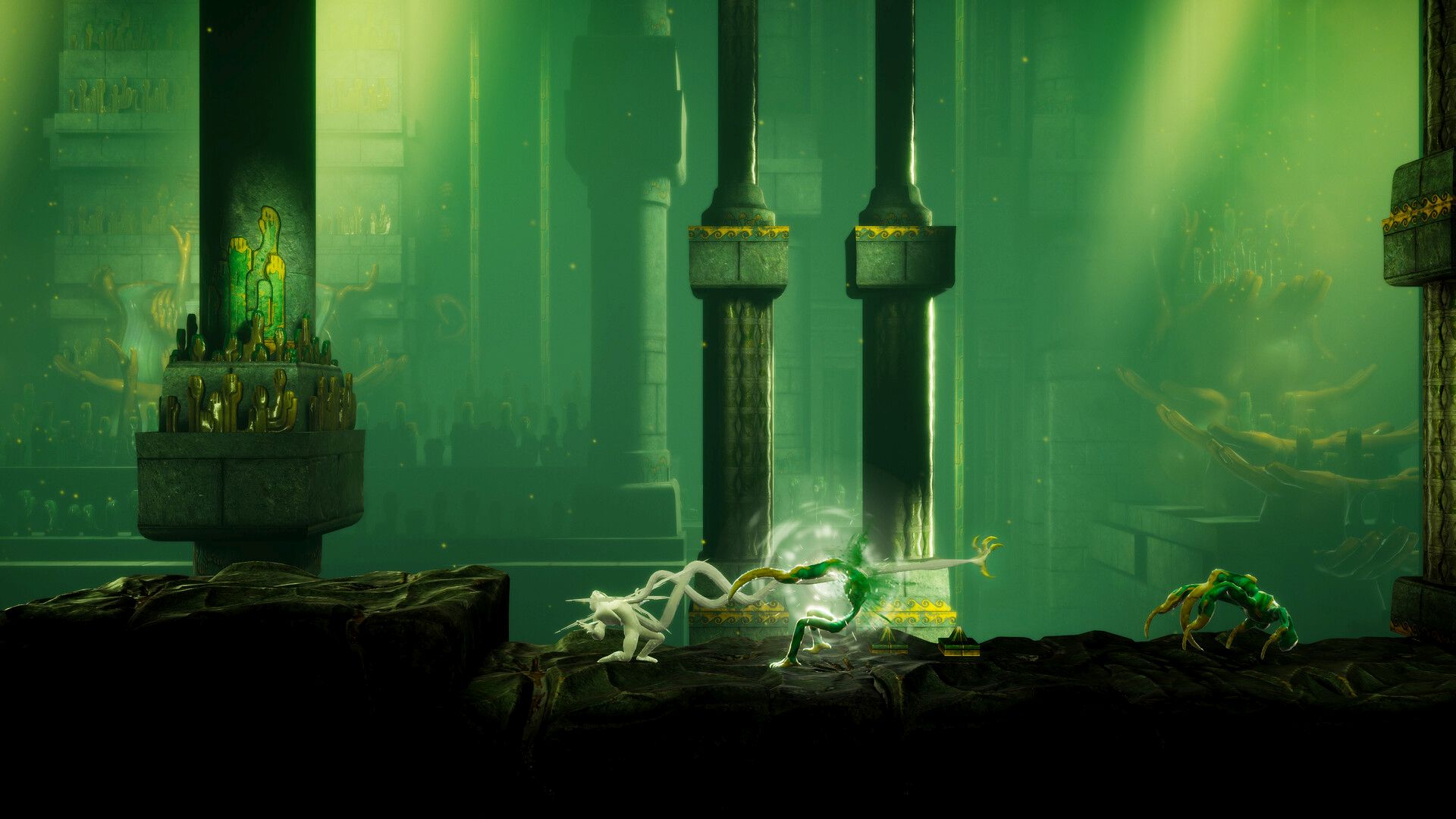
For all its color and artistry, Grime 2 still manages to include all the staples of Metroidvanias and platformers. Collapsing platforms, spikes, toxic waterfalls and many other hazards make an appearance. Overall, it’s an interesting, secret-filled map to explore, even if it does stick pretty closely to the template for the genre.
Bio-Mechanics
Like in the first game, Grime 2’s narrative might be charitably called opaque. The story suggests a world, and the world is primarily a stage for exploration and combat. Combat and movement are probably the areas in which Grime 2 makes the most changes and refinements.
Grime leaned hard into its Soulslike elements, with successful parrying being the only solution to defeating some enemies. In Grime 2, parry-gods can still reign supreme, but there are now many options for most situations, whether they be weapons, special attacks or the new Molds.
Somewhat akin to a short-time, limited use summon, Molds are learned from defeating enemies and can be used in battle. Molds are little copies of enemies, and can be used both offensively and defensively. For example, one Mold might be a temporary target for a boss to attack while the player heals. Generally, the Molds are useful but rarely able to do a ton of damage. The player can have four Molds active at any one time, and “recharges” them from combat and pick ups.

Swing Into the Fray
Another addition to Grime 2 is the game’s multi-use grappling hook. It’s used for everything from climbing to landing devastating attacks in boss battles. Controlled by the right thumbstick, it’s also the mechanic that can feel most fiddly and imprecise during platforming. There are many sections where the player has to jump, air-dash through spikes, aim the grappling hook and hit the button to attach it. It’s a sequence that would be at home in many platformers. What frustrates is trying to aim it with the thumbstick, which tends to drift its focus.
Grime 2’s combat remains the strongest element. The array of heavy-but-slow weapons, fast weapons, ranged weapons and balanced weapons is satisfying to explore. Each weapon has the usual light, heavy, charged and special attacks. There are environmental elements that the player can use, with the caveat that enemies can use them, too. There lots of bosses and most of them have clearly articulated patterns and weak points or openings.
Like the first game, combat can be punishing in the way we Soulslike players enjoy. For the less masochistic, there are some welcome combat modifiers. For instance, damage that enemies take can be cranked up to 200%, which doesn’t entirely trivialize bosses but comes close at times. In most situations, and for most enemies, there are lots of ways to be successful. Grime 2 definitely expands the palette of choices. And if nothing works, there’s always the Soulslike tradition of just running past everything.

Brushstrokes
Artistically, Grime 2 is like the more colorful, slightly less grotesque cousin of the first game. Alex Roe’s music, however, takes an even more dramatic turn from the moody to the richly orchestral and even melodic. Overall, the sound design is excellent. Grime 2 is not an excessively demanding game when it comes to tech, and it runs without issue.
I was a fan of Grime’s take on the Metroidvania/Soulslike formula. Grime 2 adds depth, polish, and variety to combat mechanics while making the experience a bit more accessible. Grime 2 literally begins with a question about how artists balance the new against what they’ve already done. Definitely a closely-related sequel and not a dramatic reinvention, there are a few frustrating platforming mechanics and a narrative that is only slightly less impenetrable. Grime 2 definitely deserves to break more fully into the mainstream this time around.
***PC code provided by the publisher for review***
The Good
- Engaging combat mechanics
- Good music’
- Colorful, surreal visuals
- Interesting theme
The Bad
- A few frustrating controls
- Vague narrative
- Regular difficulty might be too easy for some