Dune: Awakening Review
Because Frank Herbert’s original novel appeared 60 years ago, I suspect that nowadays most people know the world of Dune through film, television, and games. Not me. I know Dune because that book — alongside Lord of the Rings, of course — was once part of the grueling Nerd Card exam, along with playing arcade games and demonstrating social awkwardness via a rousing session of D&D. Think of it as the Nerd Triathlon, minus any physical exertion whatsoever. In any case, Dune remains foundational sci-fi, and I’m always happy to revisit its setting. Dune: Awakening nails it.
Alt History
Most people vaguely aware of Dune know that it mostly takes place on a harsh desert planet called Arrakis. Arrakis is home to an important resource called spice melange, valuable for everything from space travel to psychic prognostication. Several houses or factions are vying for control of Arrakis and spice. The whole thing is probably a grand allegory for unchecked colonialism, religious fundamentalism, resource exploitation, and empire building.
Although Dune: Awakening includes the fundamental narrative elements of the Dune universe, it’s a prequel or alternative history of sorts where Paul Atreides never existed. Warring houses Atreides and Harkonnen are part of Arrakis’ fabric as joinable factions, each with a host of specific perks and alliances. A number of story elements from the novels make an appearance, but Dune: Awakening’s premise is pretty simple. You are an undercover agent for the powerful Bene Gesserit, searching for the planet’s native Fremen.

The game begins with a character creator, and it isn’t a bad one, though the apparent choice of combat specializations might be less impactful than it seems. More on that later.
Taking the Heat
More than most MMORPGs, Dune: Awakening is a survival and crafting game, with a series of very familiar but generally satisfying loops. You collect resources, unlock an escalating series of blueprints, and craft items for survival and combat. In the early game, this process moves pretty quickly and is very rewarding, but as the mid- and late-game approaches, the grind for materials becomes more formidable. Having online buddies in your faction helps with this, of course. Solo players will need to set aside some serious time for grinding.
The survival hook here is Arrakis itself, and the planet’s specific and very harsh conditions. A great many things will ruin your day. Sunstroke sets in if you don’t dart between shadows during the daytime. For many early hours and beyond, thirst will be a constant concern, and there are few good ways to slake it. There’s no concern for hunger, but thirst is a perpetually annoying need. Of course, you can’t hide under a rock, as tempting as that is. For one thing, you probably need to destroy that rock for materials. The game does an excellent job of drip-feeding its mechanics in the tutorial area. By the time you’re ready to move on, you’ve got a good grasp of the fundamentals.
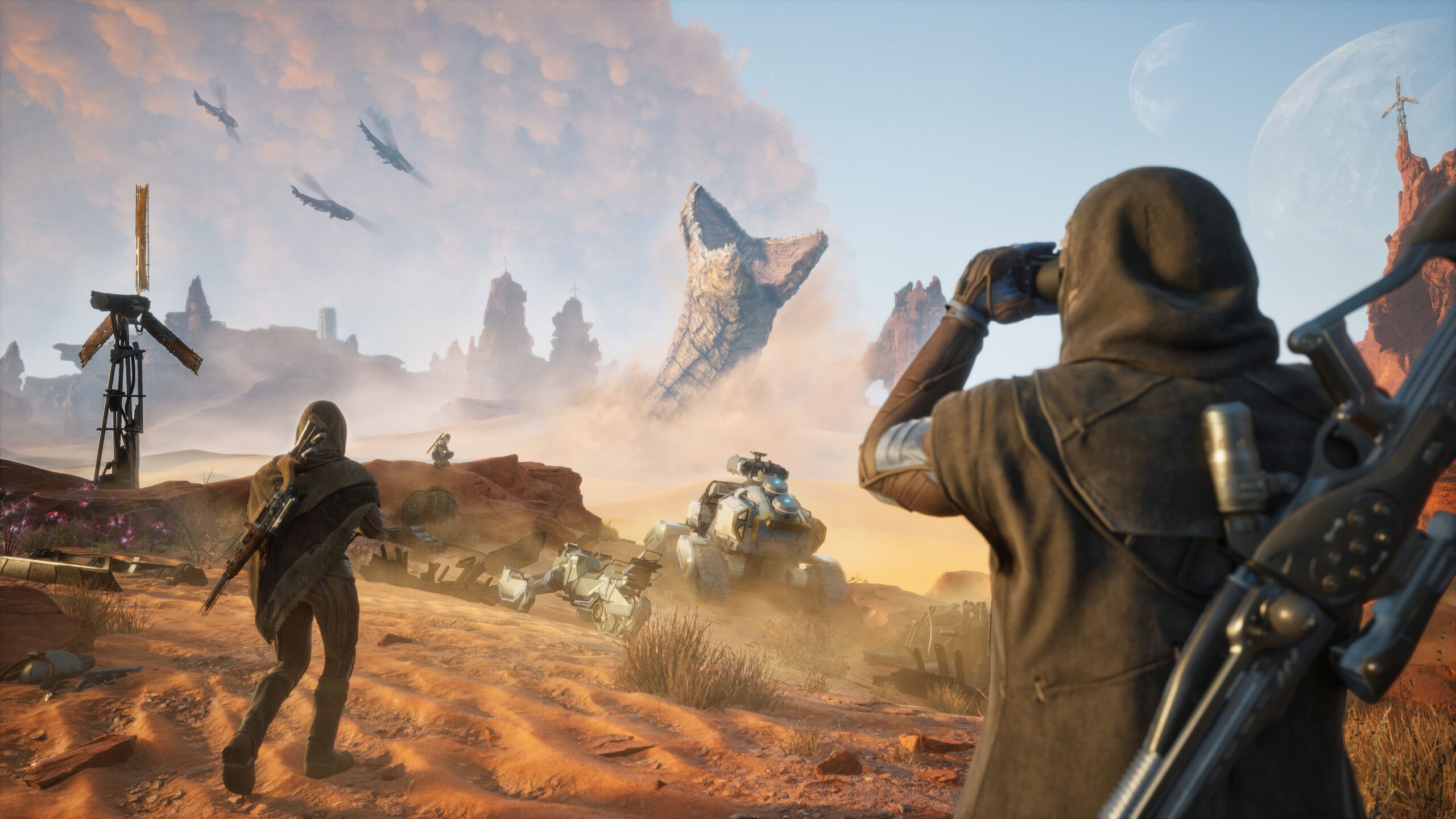
Arrakis is a challenging world, and it provides lots of ways to die. In most MMORPGs, death is an inconvenience to one degree or another. That’s true in Dune: Awakening, too, but the game raises the stakes via two iconic environmental hazards: sandworms and sandstorms. They’re both terrifying because if you die from either, you literally lose everything. No corpse run allowed. Some might argue that it’s an overly punishing mechanic, but hey, Arrakis is not a friendly place.
Fight On
Combat is an aspect of Dune: Awakening where an otherwise excellent game takes an unfortunate nosedive. There’s no getting around it: combat is just not good. While you can specialize in bladed weapons, they’re ineffective for most of the game, which means guns are the weapon of choice. Dune: Awakening takes some stabs — pun intended– at giving melee some love. There are dodges and parries, though neither feels great. The problem is that most enemies have guns and start shooting at you from range. Your pathetic little knife or even high-end katana is useless until you close the distance.
Even when combat is balanced in terms of weapons and enemies, there’s little feeling of weight or satisfying impact. Slicing and dicing feels anemic. Popping off headshots with a rifle is impossible thanks to the bullet sponge enemies. Elite field enemies will follow you relentlessly across the map, seemingly immune to thirst and sunstroke. Weapon switching means using the radial dial in the thick of an encounter. It’s disappointing because combat in other Funcom games like Conan Exiles is far better. I tried to avoid combat as much as possible, but a lot of the time, it can’t be.
What a Wonderful World
Aesthetically and graphically, the world of Dune: Awakening looks like you probably imagine. It excels in vast landscapes, terrifying weather events, and moody lighting. With the exception of cut-scenes, human character models are fine but not amazing, and structures include a lot of repeated and not very detailed assets. Overall, Arrakis looks believable, and the game’s eclectic musical score helps with the cinematic feel.
Performance-wise, Dune: Awakening still had a few issues a week or so after launch. I experienced a few crash/disconnect events, lots of pop-in/pop-out textures and objects, and some framerate stutters.

Playing Dune: Awakening is an uneven experience. The survival and building loops start strong, then eventually bog down, but experiencing the Dune universe and Arrakis is always engaging. If the game’s combat could reach the heights of its stellar world-building, Dune: Awakening would be very hard to put down. As it is, the game’s crafting/survival loops are just strong enough to keep me playing when its combat tempts me to stop.
***PC code provided by the publisher for review***
The Good
- Excellent crafting and survival experience
- Great fan service
- Authentic world building
- Good early game pacing
The Bad
- Actively poor combat
- Grindy in the later game
- Narrative fades to the background
- Some repeated assets
- A few bugs