Respawn’s patch notes are full of small numbers and quiet hotfixes. Knowing how to read them tells you more about the next season than any trailer.
Featured image: our own graphic, free to publish with this article. Download: https://nlyossymonmfa8gu.public.blob.vercel-storage.com/outreach/reading-apex-legends-patch-notes-featured.jpg
Every Apex Legends season starts with a trailer and a set of patch notes, and most players only watch the trailer. That’s understandable. Patch notes are long, dry and full of phrases like “reduced from 1.5 to 0.25 seconds”. But the notes are where the actual game changes, and the players who read them tend to adapt faster than the ones who find out mid-fight that their favourite ability doesn’t work the way it used to.
You don’t need to memorise them. You just need to know what to look for.
Seasons, midseasons and hotfixes
Apex changes on three rhythms. A new season brings the biggest notes, often with legend reworks, map changes and new weapons. A midseason update arrives partway through and usually tunes whatever the first half of the season exposed. Hotfixes land in between, sometimes with little warning, and they’re often where the most urgent balance changes go.
Season 30 is a good example. Its launch notes on 3 August 2026 reworked Bloodhound, replacing the old ultimate with a new one, Allfather’s Cloak. A hotfix on 25 August then adjusted that rework, and the midseason notes on 14 September changed the scan again. Anyone who read only the launch notes would have been two versions behind within six weeks.
Read the numbers, not the adjectives
Patch notes often describe changes in words: faster, stronger, more reliable. The words are useful, but the numbers tell you the size of the change.
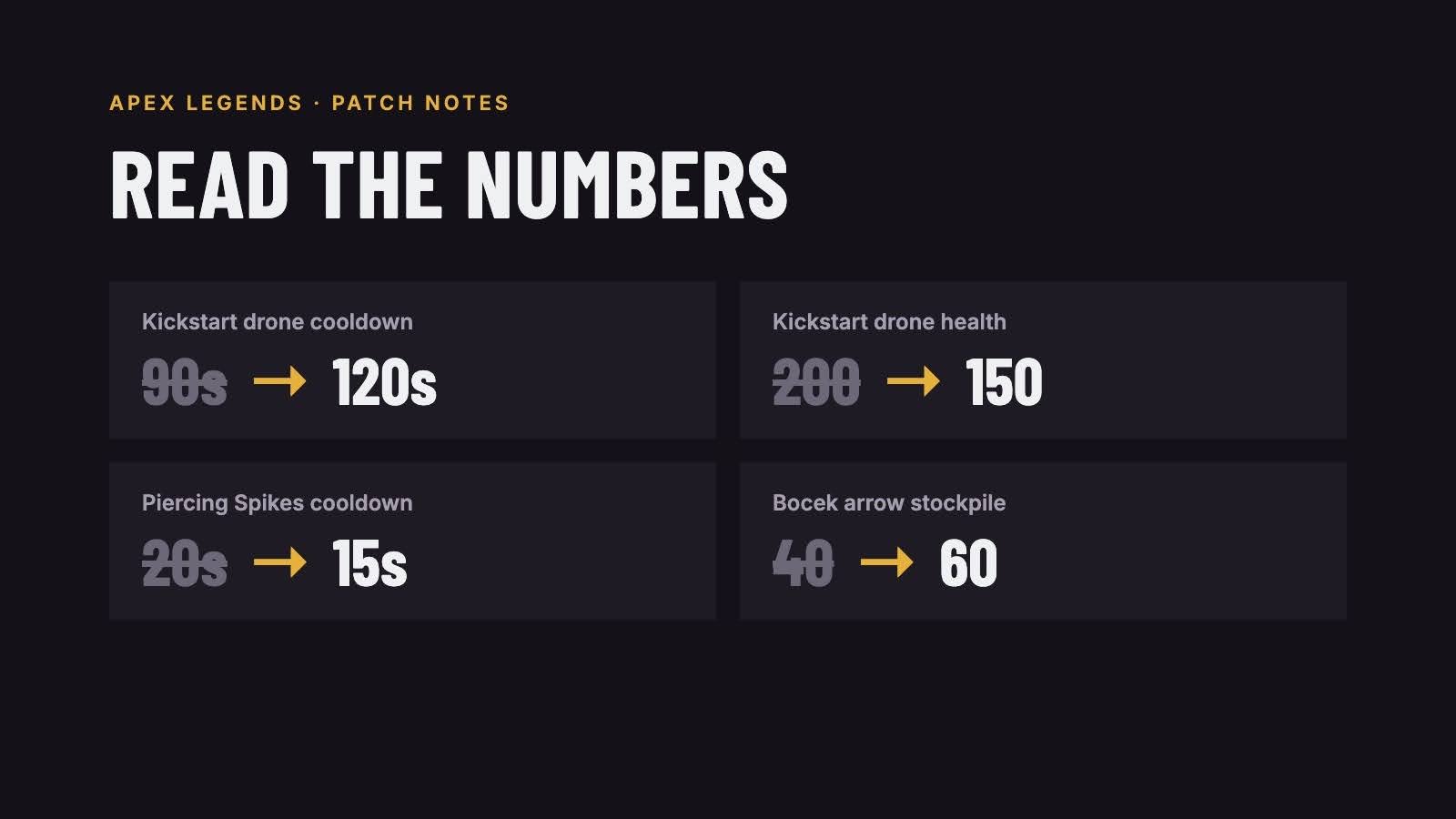
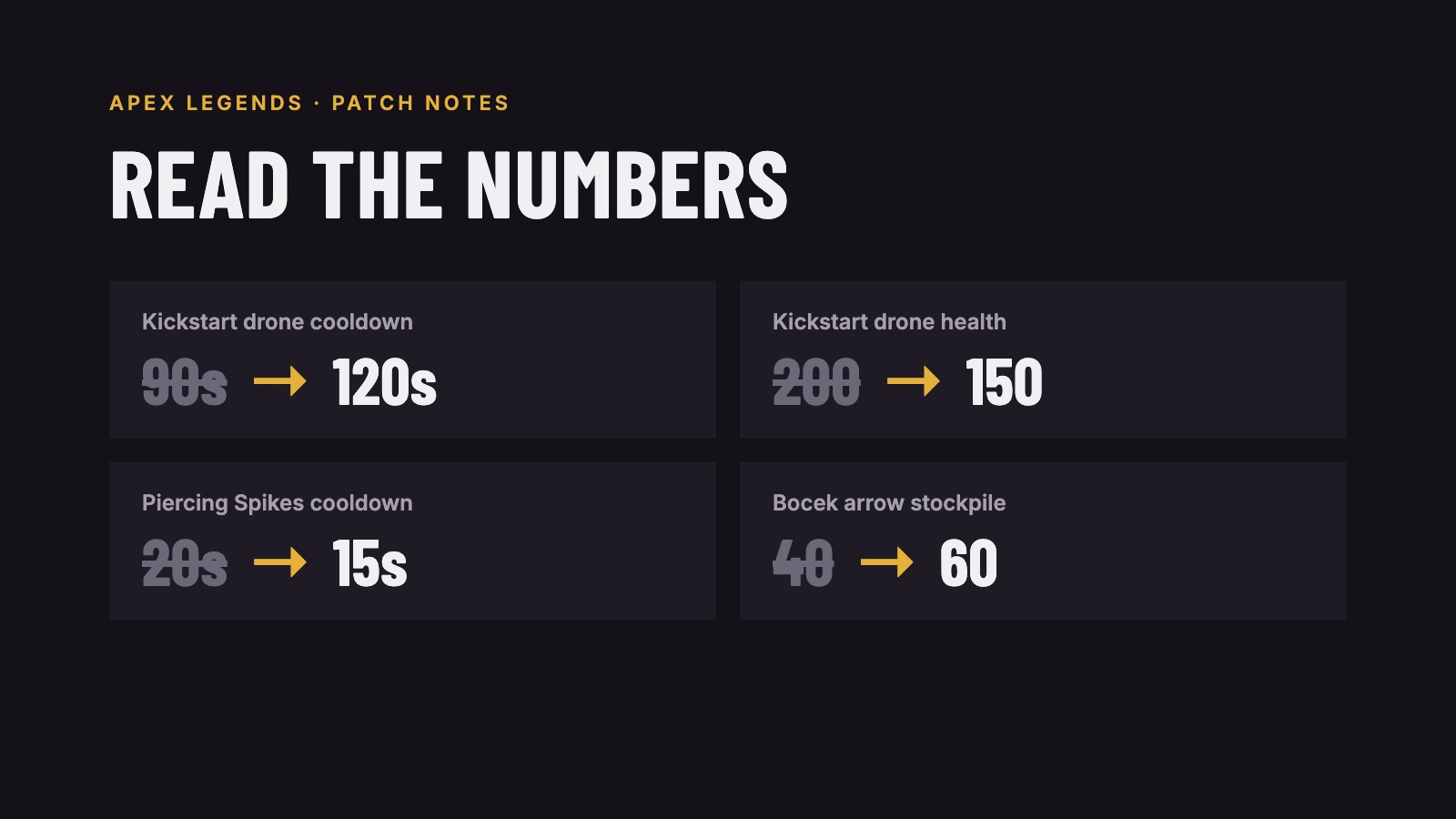
When Axle’s Kickstart drone went from 200 health to 150 and its cooldown from 90 seconds to 120 in the August hotfix, that wasn’t a light touch. It was a third longer between uses and a quarter less durability, both at once. Catalyst’s Piercing Spikes going from a 20-second cooldown to 15 is a similar-sized change in the other direction.
Sometimes EA doesn’t publish a number at all, only a direction. The Triple Take’s faster fire rate while aiming down sights is described that way in the midseason notes. When that happens, the honest reading is that it’s faster, and by an amount you’ll have to feel out in the firing range.
Watch for changes that move together
Single changes rarely shift the meta on their own. Clusters do. If several legends who counter the same playstyle all get nerfed in one patch, that playstyle is about to get more common. If a weapon class gets buffed at the same time as the legends who use it best, expect to see a lot more of both.
The Season 30 midseason notes buffed Catalyst, Conduit and Fuse in one go. Each change is modest on its own, but together they push support and area-control kits forward, and that shapes what squads look like in the weeks that follow.
Weapons tell the same story
Weapon notes follow the same pattern, and they’re often the quickest to act on. The Season 30 midseason update raised the Bocek Compound Bow’s arrow stockpile to 60 from 40, with 10 explosive arrows per energize instead of 7. The Charge Rifle’s maximum damage at range went to 110 from 99, reached beyond 200 metres. Neither change is huge on paper, but a bow that rarely runs dry and a rifle that hits harder at distance both reward picking them up when you might once have walked past.
Pay attention to the conditions attached to a number, too. “At range” and “while aiming down sights” narrow a change to specific situations, and that tells you when the weapon is meant to shine.
Upgrades complicate everything
Apex legends now have upgrades that unlock as you level up during a match, and patches regularly add, remove and move them. Those changes are easy to miss because they don’t affect the base ability. Axle’s August hotfix, for example, swapped an upgrade called Jump Gate for one called Drone Deployer, which brings the drone’s cooldown back to 90 seconds. A nerf with a built-in path back to the old number plays very differently from a straight nerf.
When you read a legend’s notes, check the upgrade lines as carefully as the ability lines. That’s often where the real balance decision is hiding.
Keep a reference handy
Patch notes are written for a single moment. A month later, when you want to know what a legend’s cooldown actually is now, you’d have to stitch together the launch notes, a hotfix and a midseason update yourself. That’s where a reference that keeps the current values in one place helps. apexdb, an Apex Legends database, lists each legend and weapon with its current numbers and the patch that last changed them, which saves a lot of scrolling through old notes.
Reading notes makes you a better player
Nobody needs to treat patch notes as homework. But spending ten minutes on them at the start of each season, and again when a midseason drops, tells you which legends are about to feel different, which guns are worth picking up and which old habits to drop. That’s a better edge than most settings tweaks, and it costs nothing.