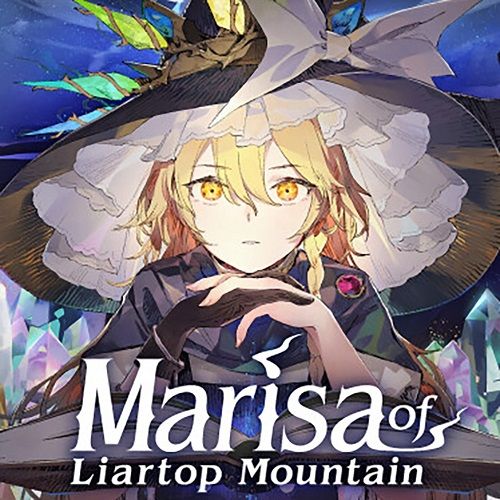
Marisa of Liartop Mountain Review
Marisa of Liartop Mountain is a turn-based adventure RPG that is basically a digital tabletop gamebook. In this title, dice rolls and player decisions determine the outcome of a branching narrative. The result is a charming little quest that would be better if it allowed for more strategies to be actually useful.
In the magical land of Gensokyo, the last bastion of fantasy, there is a mansion. Inside, four magical girls are playing a game.
The vampires Remilia and Flandre Scarlet, the magician Patchouli, and the maid Sakuya sit around a book. Inside the book’s pages, the irreverent shrine maiden Reimu Hakurei plunges into another adventure.
Despite not having Touhou in the title, this game is a spinoff of the Touhou Project franchise. It makes no effort to introduce the cast before plunging them into a fantastical meta adventure. If you’re not already a Touhou fan, you’ll probably be pretty confused. However, series veterans will enjoy the banter and characterization.
Girls are Now Gaming
Marisa of Liartop Mountain starts with Patchouli suggesting the four girls in the mansion play a game. The game, however, is focused on someone they know: Reimu.
Reimu’s friend Marisa has disappeared, leaving only a giant storybook as a clue. When Reimu touches the book, she gets sucked into it. Her quest to find Marisa will take her through a surreal land that works on very strange rules. All while the girls from the mansion make decisions and roll dice to guide her actions.

To find Marisa, Reimu must fight five monsters that have borrowed Marisa’s shape. Each of them has their own reason for fighting Reimu. And none of them are going to let the girls reunite easily.
As Reimu ventures deeper into the unknown, the four girls can provide advice or suggest upgrades. However, heeding their words will give them more influence over her. And nobody ever said the women of Scarlet Devil Mansion have Reimu’s best interests at heart.
Each dice has a limited number of uses and you can only hold so many at a time. Combat involves making choices and having the outcome determined by rolling. Although the game is mostly a stress-free experience you can take at your own pace, there are some timed choices. Each playthrough is about 20 hours, but the game is pretty cheap.
Marisa of Liartop Mountain Has Ambition But Not Polish
Marisa of Liartop Mountain uses an intriguing multimedia approach to its graphics. It uses both anime-style character portraits and 3D graphics to create the illusion of a game board. ‘Players’ are represented with detailed portraits, while the board and the pieces on it are designed to look like game miniatures.

The Japanese voice acting and narration are decent, but I found myself skipping over narrator after the first few chapters. However, the soundtrack is quite good. Its gentle and sometimes ominous tunes add to the feeling of otherworldliness. This keeps the mood of Reimu’s adventures both wonderful and a bit intimidating.
Reimu gains experience from combat, but also from solving puzzles or interacting with her surroundings. At each level up, she chooses from four randomized power-ups. Each comes recommended by a different girl watching her journey. Some come with extra dice or different dice. This game feels very much like playing a collaborative tabletop RPG, especially when the four girls comment on Reimu’s encounters and bicker over her options.

Depending on your build, your choices, and how thoroughly you explore, the game’s difficulty can vary a lot. By which I mean, it is entirely possible to be softlocked without warning if you didn’t prepare your build properly. There’s also a fair bit of missable content–mostly combat, but also a few puzzles.
Falls Off in the Second Half
Marisa of Liartop Mountain has a few major problems. The biggest of which is also the simplest: after the first couple chapters focus more on adventure and exploration, the second half of the game becomes more linear and gimmicky.
The shift is disappointing, especially since boss fights generally have one strategy you must use to win. If you can’t roll the right numbers, you have to restart the chapter. Not only does this hamper the feeling of playing a tabletop RPG with friends, repeating a gimmicky level can be quite frustrating.

The sheer variety of dice allows for a lot of customization options. However, it also means you can get softlocked if you don’t have the right dice available.
All in all, Marisa of Liartop Mountain is a cute little game that pretends to be complicated than it is. If you’re a Touhou fan who doesn’t mind restarting if necessary, you’ll have fun. Everyone else is likely to get annoyed and drop it.
***Steam code provided by the publisher***
The Good
- Cute visuals
- Lovely soundtrack
- Interesting narrative
- Interesting dice mechanics
The Bad
- Second half gets very linear
- Boss fights have few options
- Easy to get softlocked
- Short