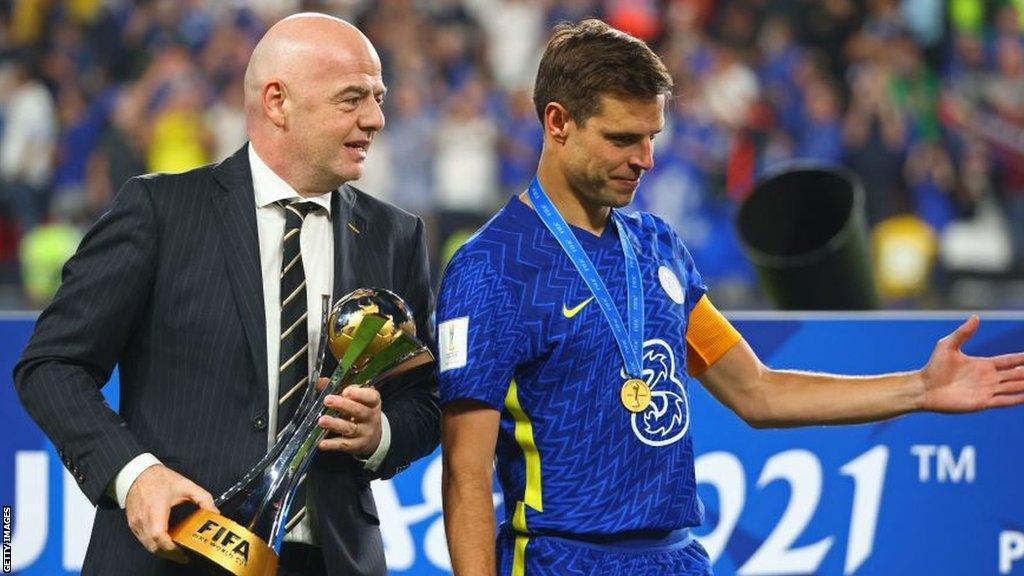
When Chelsea last won the Club World Cup, in February 2022, the job took two matches in Abu Dhabi and about $5 million in prize money. Three and a half years later, the same title required seven matches across the United States and paid Chelsea more than $150 million.
That gap explains why FIFA rebuilt its club competition from scratch. The move from a short annual event to a 32-team tournament every four years changed who qualifies, how the money flows and how much the event asks of players.
Why FIFA Wanted A Bigger Club Event
FIFA first staged a club world championship in Brazil in 2000, when Corinthians beat Vasco da Gama on penalties in an eight-team event. A second edition planned for Spain in 2001 was cancelled after the collapse of FIFA’s marketing partner ISL, and the competition returned only in 2005 in Japan, absorbing the old Intercontinental Cup between Europe and South America.
From then on, the Club World Cup brought together the six continental champions, and from 2007 it added the league champion of the host country. It was usually squeezed into December, and European clubs won every edition from 2013 to 2023, often after playing only a semi-final and a final.
Corinthians, who beat Chelsea in the 2012 final, remain the last club from outside Europe to lift the old trophy. For FIFA, the one-sided results and limited interest in Europe meant the event earned far less than its name suggested.
A 24-team version was planned for China in 2021, then postponed when the pandemic pushed Euro 2020 and the Copa América into that summer. In December 2022, Gianni Infantino announced a 32-team format every four years from 2025, and the United States was confirmed as host in June 2023.
Old Format Versus New
The changes run through almost every part of the competition, from the number of clubs to the way matches reach viewers. The comparison below sets the last seven-team editions beside the first 32-team tournament, with all money in US dollars:
|
Feature |
Seven-team format (2007–2023) |
32-team format (2025) |
|
Clubs |
Six continental champions plus the host league champion |
32 clubs from all six confederations |
|
How often |
Every year |
Every four years |
|
Length |
About 10 days, usually in December |
One month, 14 June to 13 July |
|
Hosts |
Japan, UAE, Morocco, Qatar or Saudi Arabia |
11 cities in the United States |
|
How clubs qualified |
Winning that season’s continental title |
Continental titles and rankings over four seasons |
|
Matches for a European winner |
Two |
Seven |
|
Money on offer |
About $5 million for the winner |
About $1 billion in total, with up to $40 million for winning the final alone |
|
Broadcast |
Rights sold market by market |
DAZN streamed all 63 matches free worldwide |
The new format also filled a month of the northern summer, so the biggest clubs lost part of their usual break and pre-season. That trade-off sits behind much of the criticism that followed the first edition. For smaller clubs the money changed the calculation, since even Auckland City’s participation fee of about $3.6 million was a large sum for a team of part-time players.
Headline numbers rarely tell the full story, in football or anywhere else. A hiddenjack review is most useful when it tests the online casino on details the marketing skips, such as which studios supply its games, whether live chat answers at any hour and how quickly complaints are resolved.
How The 32 Clubs Qualified
Qualification ran over four seasons, from 2021 to 2024, so most clubs had earned their places long before a ball was kicked in the United States. The main routes and rules were these:
-
Continental champions: every winner of a confederation’s top club competition in that window qualified, which brought in Chelsea, Real Madrid and Manchester City through the Champions League.
-
Ranking places: the remaining spots went to the best-ranked clubs over the four seasons, giving Europe 12 places in total and South America six.
-
A two-club limit per country: no nation could send more than two clubs unless more had won continental titles, which kept Liverpool out despite its high ranking.
-
A host slot: Inter Miami took the United States place as winner of the 2024 MLS Supporters’ Shield.
-
Ownership checks: Mexico’s Club León was removed because it shared an owner with Pachuca, and LAFC took the place after beating Club América in a play-off.
-
One place for Oceania: Auckland City, a team of part-time players, qualified as the region’s top-ranked club.
The León ruling showed how much a bigger format depends on rules written in advance, because a tournament worth this much money invites legal challenges. León took its case to the Court of Arbitration for Sport and lost.
What The First Edition Proved
On the field, the tournament delivered more surprises than many expected. Botafogo beat Paris Saint-Germain, Flamengo beat Chelsea 3-1 in the group stage, and Al Hilal knocked out Manchester City 4-3 after extra time in the round of 16.
All four Brazilian clubs reached the knockout rounds, and Inter Miami’s 2-1 win over Porto was the first competitive victory by an MLS team over European opposition. Fluminense went as far as the semi-finals before losing to Chelsea, who then beat PSG 3-0 in the final at MetLife Stadium in front of 81,118 fans, with Cole Palmer scoring twice and setting up João Pedro.
Off the field, FIFA reported an estimated global audience of 2.7 billion, while DAZN streamed every match free around the world. Total attendance reached about 2.49 million, an average of roughly 39,500 per match.
The Case Against
Critics found plenty to dislike, and the sharpest complaints, several of them from inside the game, were these:
-
Heat: many matches were played above 32°C, and Chelsea’s Enzo Fernández said playing in such temperatures was very dangerous.
-
Storms: six matches were halted by severe weather, adding almost eight and a half hours of delays in total.
-
Empty seats: crowds filled about 62% of capacity, and one semi-final ticket that first sold for $473.90 later fell to $13.40.
-
Workload: Pep Guardiola said his players were exhausted, and Jürgen Klopp called the tournament the worst idea ever implemented in football.
-
Pitches: Dortmund coach Niko Kovač said the grass at MetLife Stadium was cut so short that it played more like a golf green.
-
Mismatches: Bayern Munich beat Auckland City 10-0 and Benfica added a 6-0 win, which fed doubts about including part-time sides.
Auckland City also produced one of the warmest stories of the month by holding Boca Juniors to a 1-1 draw. That result gave supporters of the format a ready reply to the mismatch argument.
The Road To 2029
FIFA has moved to expand the next edition to 48 clubs, with Europe’s share expected to rise from 12 to 16, although the full allocation had not been published by late 2026. The tournament is set for June and July 2029, and Australia, possibly with New Zealand, is among the countries that have shown interest in hosting it, alongside Brazil, Mexico and the United States.
Relations with Europe remain a major risk for the competition. In July 2026, UEFA’s 55 member federations threatened to boycott FIFA competitions over a plan to sell a stake in FIFA’s commercial arm, and FIFA dropped the plan a day later.
Between editions, the annual FIFA Intercontinental Cup keeps a world club title in the calendar. Real Madrid won the first edition in 2024, and PSG beat Flamengo on penalties in Doha in December 2025.
Final Thoughts On The New Format
The Club World Cup became a 32-team tournament because FIFA wanted a club event with the scale and income of a World Cup. The 2025 edition delivered the money, a global audience and several real upsets, but it also brought heat, empty seats and fresh worries about player workload.
With a 48-team version planned for 2029 and FIFA’s relationship with UEFA still strained, the format is far from settled. How well it handles those tensions will decide whether the expanded event becomes a fixture or stays an expensive experiment.
FAQ
How many teams play in the Club World Cup?
The 2025 edition had 32 clubs in eight groups of four, with the top two in each group reaching the round of 16, and FIFA plans a 48-club field for 2029.
Who won the first 32-team Club World Cup?
Chelsea won it by beating Paris Saint-Germain 3-0 in the final at MetLife Stadium on 13 July 2025, with Cole Palmer scoring twice and João Pedro adding the third.
How often is the Club World Cup played?
The expanded Club World Cup is held every four years, while the annual FIFA Intercontinental Cup, won by Real Madrid in 2024 and PSG in 2025, fills the years in between.
Why did Liverpool not play at the 2025 Club World Cup?
A limit of two clubs per country applied, and Chelsea and Manchester City had already taken England’s places as Champions League winners in 2021 and 2023.