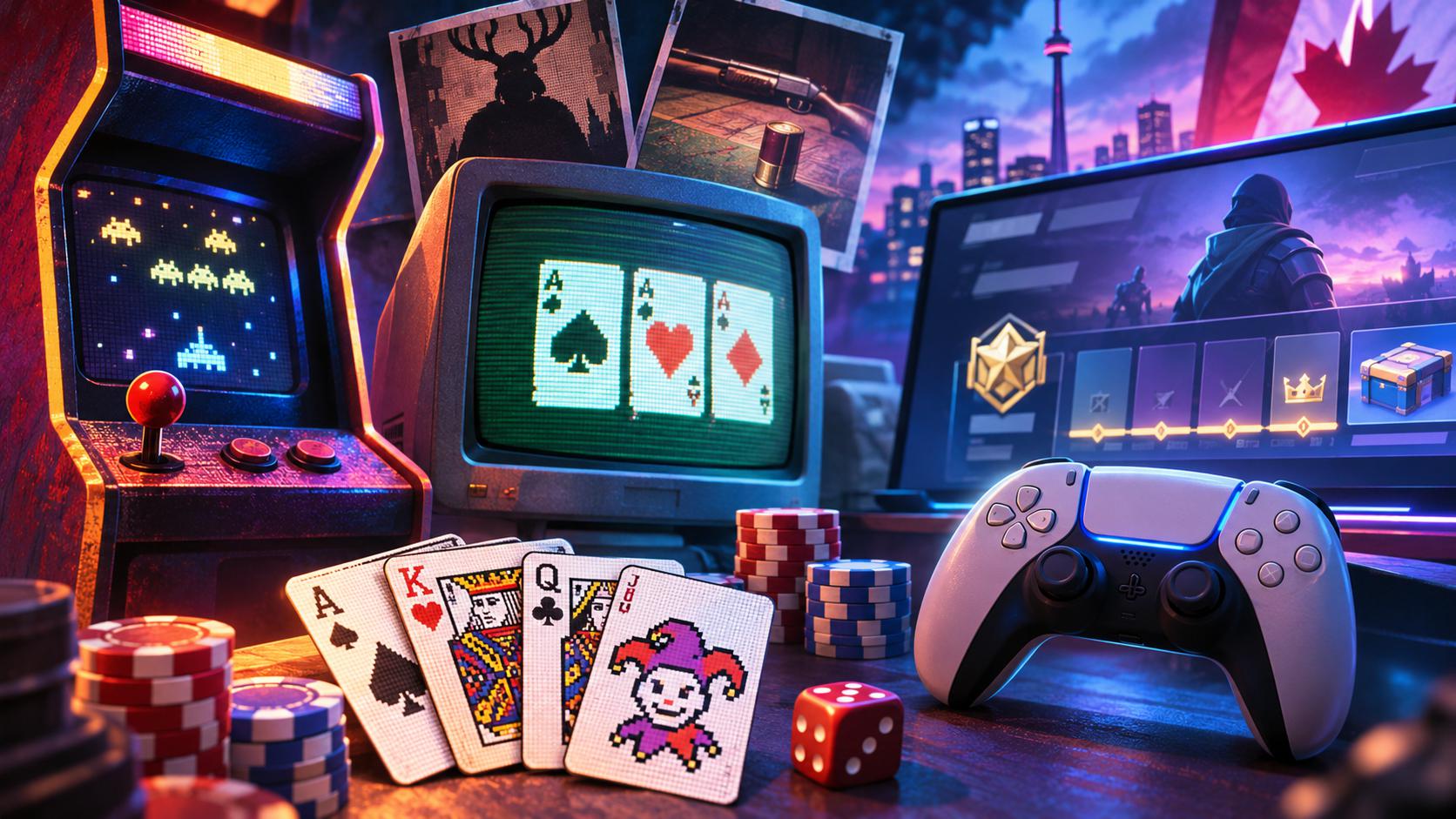
Who would have thought that a deck of playing cards could compete with some of gaming’s biggest productions? Canadian solo developer LocalThunk proved it was possible with Balatro, a poker-inspired roguelike that turned familiar card combinations into an addictive cycle of escalating scores, strange Jokers, and increasingly ridiculous multipliers.
Alongside Buckshot Roulette and Inscryption, its success highlights a growing fascination with tactile tabletop aesthetics. While modern live-service games surround players with battle passes, seasonal challenges, and sprawling menus, these indie hits keep their most important mechanics front and centre.
It’s a fascinating contrast, especially when you consider how much game interfaces have changed since the arcade era.
Why Tabletop Aesthetics Are Taking Over Indie Gaming
Steam’s indie scene has embraced playing cards, poker chips, and tabletop mechanics in a big way. Long before Balatro became a breakout hit, digital card interfaces had already established their appeal, from classic PC solitaire collections to the streamlined game lobbies of online casinos Canada players can access. Familiar layouts, recognizable symbols, and immediate visual feedback make these interfaces easy to understand.
What makes the latest wave interesting is how developers have repurposed those conventions.
Balatro looks like a poker game running through an old CRT monitor, but underneath its retro presentation is an intricate scoring system. Jokers modify the rules, planet cards upgrade poker hands, and multipliers can turn an ordinary pair into a massive scoring opportunity. Watching chips and Mult values climb is almost as satisfying as making the right play.
Buckshot Roulette strips things down further. Its grimy tabletop, scattered items, and ominous shotgun make every decision feel dangerous. The metallic clack of the weapon being racked carries more tension than an elaborate cinematic sequence.
Then there’s Inscryption, where cards sit on a wooden table, and the surrounding darkness becomes part of the experience. These games aren’t simply borrowing casino or tabletop imagery. They’re using familiar objects to make unusual mechanics feel immediately playable.
From Quarter-Munchers to Modern Risk-Reward Loops
Arcade cabinets were built around instant comprehension. In Pac-Man, you knew what to do almost immediately: collect dots, avoid ghosts, and chase a higher score. Space Invaders communicated danger through descending enemies, while Donkey Kong made its obstacles visible before players committed to a jump.
Every quarter mattered, so the interface couldn’t afford to waste anyone’s time. Players needed to understand their remaining lives, current score, and immediate threats without digging through instructions.
Home consoles and PCs eventually introduced more complicated systems, particularly through RPGs and strategy games. Yet card-based minigames preserved some of that arcade simplicity.
Triple Triad in Final Fantasy VIII made tactical battles possible through a small grid and numbered cards. Gwent, originally introduced in The Witcher 3, expanded the concept into a strategic contest built around managing hands and deciding when to pass.
Slay the Spire pushed things further by combining deckbuilding with roguelike progression. Enemy intentions appear above opponents, while energy costs and card effects remain visible throughout combat. Players can calculate whether to block, attack, or gamble on drawing something better.
That’s the same fundamental tension arcade designers understood decades ago: players need enough information to make a decision, but enough uncertainty to make that decision exciting.
From Arcade Buttons to DualSense: Making Digital Games Feel Physical
There’s something satisfying about pressing a real arcade button or moving a mechanical joystick. Modern developers have spent years recreating that physical connection through sound, animation, and controller feedback.
Balatro is particularly good at it. Cards snap into position, scoring effects accelerate, and the distinctive audio accompanying rising multipliers makes a successful hand feel explosive. Even rearranging cards has a pleasing rhythm.
In Buckshot Roulette, the shotgun’s mechanical sounds and deliberate reload animations make its tabletop confrontation feel uncomfortably tangible.
Canadian-made Cuphead, developed by Studio MDHR, offers another example of presentation shaping interaction. Its hand-drawn animation recreates the look of 1930s cartoons, but the precise timing of attacks, parries, and hit reactions keeps the action readable beneath the visual spectacle.
Modern controllers add another layer. PlayStation 5’s DualSense supports nuanced haptic feedback and adaptive triggers, while Nintendo Switch and Xbox controllers provide vibration feedback that can reinforce on-screen actions.
For portable players, whether using a Nintendo Switch, Switch 2, or PC handheld, these small interactions matter. A readable card layout and satisfying button response can make a short gaming session feel complete without requiring a lengthy tutorial or complicated menu navigation.
How RNG Turned Uncertainty into a Gameplay Mechanic
Random number generation has been part of gaming for decades, but modern roguelikes put it directly at the centre of their design.
In Slay the Spire, shuffled decks and randomized encounters create unpredictable situations. However, players can still inspect enemy intentions, calculate available energy, and choose which cards to play.
Balatro approaches uncertainty differently. You might be chasing a flush, only to discover that your remaining discards make a safer full house more practical. Jokers and consumable cards introduce additional variables, rewarding players who understand how different scoring effects interact.
The important distinction is that randomness doesn’t replace skill. It creates situations where players must adapt.
Buckshot Roulette demonstrates this particularly well. Knowing how many live and blank shells remain doesn’t guarantee the next outcome, but it gives players information they can use when deciding whether to shoot, use an item, or take another risk.
A good interface makes those decisions understandable without revealing everything.
What AAA Live-Service Hubs Can Learn from Minimalist Card UI
Compare Balatro‘s main screen with the menus of a modern live-service game, and the difference becomes obvious.
In Dead by Daylight, developed by Montreal-based Behaviour Interactive, players navigate character loadouts, perks, the Bloodweb progression system, seasonal events, and cosmetic collections. During matches, however, the interface becomes much more focused. A skill-check needle and highlighted success zone communicate a precise timing challenge in seconds.
Rainbow Six Siege, developed by Ubisoft Montreal, faces similar demands. Operator selection, weapon attachments, equipment choices, and seasonal content require extensive navigation, but the actual match interface must keep tactical information readable under pressure.
Neither game can realistically reduce its entire experience to a handful of cards. Their systems are simply too extensive. Still, their moment-to-moment gameplay demonstrates how effective focused interfaces can be.
The Video Games Canada (previously Entertainment Software Association of Canada (ESAC)) regularly documents gaming activity across the country’s PC, console, and mobile audiences. For players moving between different devices and session lengths, unnecessary interface friction can become especially noticeable.
That’s where indie developers have an advantage. Balatro rarely makes players search for the next meaningful interaction. The cards, resources, and scoring information are already on the table.
Live-service developers could benefit from applying that same discipline to their most frequently used menus.
The Best Game Interfaces Still Understand the Player
Gaming technology has moved far beyond the physical limitations of arcade cabinets, but the appeal of clear feedback hasn’t disappeared.
Balatro, Buckshot Roulette, and Inscryption succeed partly because their interfaces make ordinary objects feel exciting again. Cards, chips, and mechanical controls become tools for building tension rather than decorative references to older games.
Meanwhile, large live-service titles demonstrate the challenges of presenting increasingly complicated systems without overwhelming players.
The next major UI innovation might involve advanced haptics, smarter navigation, or entirely new interaction methods. But the lesson from today’s indie successes is surprisingly old-fashioned: give players a meaningful choice, make its consequences visible, and ensure that pressing the button feels worth it.